

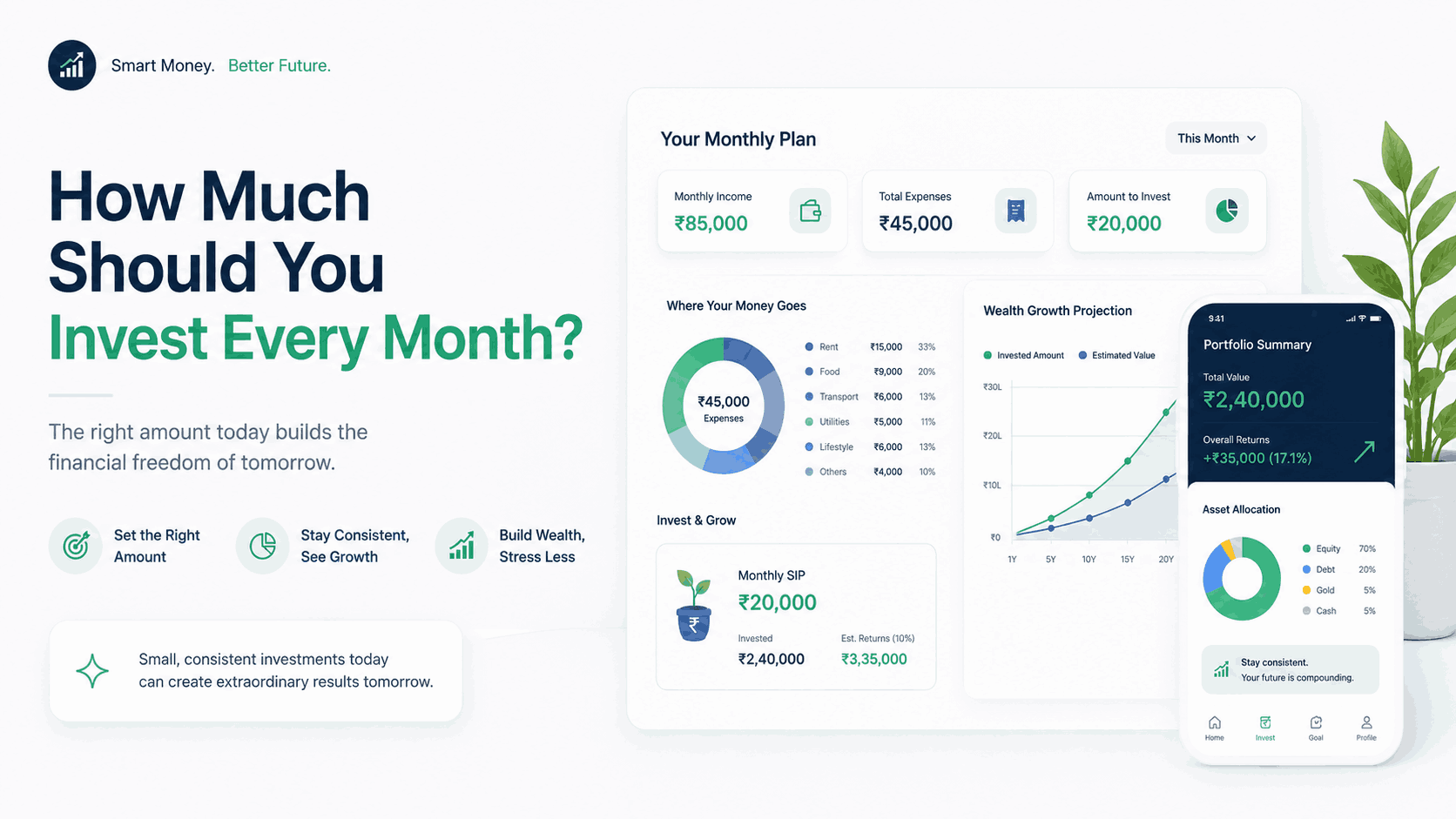
How Much Should You Invest Every Month?
One of the most common questions first-time investors ask is:
"How much should I invest every month?"
Should it be ₹5,000?
₹10,000?
20% of your salary?
Or simply whatever is left after paying your bills?
The truth is, there isn't a universal answer.
The right monthly investment depends on several factors, including your income, financial goals, lifestyle, responsibilities, and the time you have available to achieve those goals.
Many people delay investing because they believe they need a large amount to get started. Others invest random amounts without knowing whether they'll actually achieve their financial goals.
Both approaches can leave you falling short over time.
In this guide, you'll learn how to determine the right monthly investment amount, avoid common mistakes, and understand how intelligent, AI-powered investing can help you make your money work harder.
Who Is This Guide For?
This guide is especially useful if you are:
-
A first-time investor wondering where to start.
-
A salaried professional looking to Start a SIP.
-
Someone unsure whether you're investing enough every month.
-
An investor planning for retirement, a home, or your child's education.
-
Looking for a structured way to grow wealth instead of investing randomly.
If you've ever wondered whether your monthly investment is enough, this article is for you.
Why There Is No "Perfect" Monthly Investment Amount
Many financial influencers recommend investing:
-
20% of your salary
-
30% of your income
-
₹10,000 every month
While these rules can provide direction, they ignore one important fact:
Every investor's financial situation is different.
Consider these two individuals.
Investor Anurag
-
Age: 24
-
Salary: ₹40,000/month
-
No dependents
-
No loans
Investor Bhaskar
-
Age: 38
-
Salary: ₹1.8 lakh/month
-
Home loan
-
Two children
-
Retirement planning
Even though Investor Bhaskar earns much more, their monthly responsibilities are also significantly higher.
The ideal investment amount for each person will therefore be completely different.
Instead of following generic advice, your investment should be based on your own financial plan.
The Four Factors That Determine How Much You Should Invest
1. Your Income
Income naturally determines your investing capacity.
As a general rule:
The higher your income, the greater your ability to invest.
However, increasing income doesn't automatically mean increasing wealth.
Many high-income individuals also have high expenses.
The key is maintaining a healthy savings rate rather than focusing only on salary.
2. Your Financial Goals
Every investment should have a purpose.
For example:
|
Goal |
Investment Horizon |
|
Emergency Fund |
1–2 Years |
|
Buying a Car |
3–5 Years |
|
House Down Payment |
5–10 Years |
|
Child's Education |
10–18 Years |
|
Retirement |
20–35 Years |
Once you know your goal, calculating your required monthly investment becomes much easier.
3. Your Time Horizon
Time is one of the biggest factors in wealth creation.
The earlier you start investing, the less you'll need to invest every month.
Example
Suppose your goal is to accumulate ₹1 crore.
Assuming a 12% annual return:
|
Starting Age |
Monthly SIP Required |
|
25 |
~₹6,100 |
|
30 |
~₹9,800 |
|
35 |
~₹16,900 |
|
40 |
~₹30,000 |
The difference is remarkable.
Waiting just ten years can nearly triple the amount you need to invest every month.
This is the power of compounding.
A Simple Rule to Begin: The 50-30-20 Framework
If you're unsure where to start, the 50-30-20 budgeting rule is a useful guideline.
Allocate:
-
50% for essential expenses
-
30% for lifestyle and discretionary spending
-
20% for savings and investments
For someone earning ₹75,000 per month:
|
Category |
Amount |
|
Needs |
₹37,500 |
|
Lifestyle |
₹22,500 |
|
Savings & Investments |
₹15,000 |
This isn't a strict rule, but it provides a practical starting point.
How Much Should You Invest Based on Your Salary?
The table below provides an indicative investment range.
|
Monthly Income |
Suggested Monthly Investment |
|
₹30,000 |
₹3,000–₹6,000 |
|
₹50,000 |
₹7,000–₹12,000 |
|
₹75,000 |
₹12,000–₹18,000 |
|
₹1,00,000 |
₹20,000+ |
|
₹2,00,000 |
₹40,000+ |
Remember, these are guidelines—not guarantees.
Your personal goals should always take priority over generic percentages.
Why Starting Small Is Better Than Waiting
Many investors postpone investing because they think they need more money.
They tell themselves:
-
"I'll start after my promotion."
-
"I'll begin once I earn ₹1 lakh a month."
-
"I'll invest after paying off my loan."
Unfortunately, every year you delay costs you valuable compounding time.
Example
Rahul starts investing ₹5,000 monthly at age 25.
Priya waits until age 35 and invests ₹10,000 monthly.
Assuming 12% annual returns until age 60:
|
Investor |
Monthly SIP |
Retirement Corpus |
|
Rahul |
₹5,000 |
₹3.2 crore |
|
Priya |
₹10,000 |
₹3.5 crore |
Despite investing double every month, Priya only builds a slightly larger corpus because Rahul gave compounding an extra decade to work.
The lesson is simple: Start with what you can afford today.
Should You Increase Your SIP Every Year?
Absolutely.
As your salary grows, your investments should grow too.
This is known as a Step-Up SIP.
Example
Initial SIP:
₹10,000/month
Annual Increase:
10%
After 20 years:
|
Investment Type |
Estimated Corpus* |
|
Fixed SIP |
₹99 lakh |
|
Step-Up SIP |
₹1.75 crore+ |
*Illustrative values assuming 12% annual returns.
A small annual increase can dramatically improve your long-term wealth.
Common Mistakes Investors Make
Investing Random Amounts
Many people choose a SIP amount without calculating whether it aligns with their goals.
Goal-based investing is far more effective.
Ignoring Inflation
₹50 lakh today won't have the same purchasing power twenty years from now.
Always account for inflation while planning long-term investments.
Waiting for the "Perfect Time"
Markets will always fluctuate.
Trying to perfectly time the market usually leads to delayed investing.
Consistency beats perfect timing.
Stopping SIPs During Market Corrections
Market declines often make investors nervous.
However, corrections allow SIP investors to purchase more units at lower prices, which can improve long-term returns through rupee-cost averaging.
How AI Can Help You Decide How Much to Invest
Many investors don't struggle with saving money.
They struggle with questions like:
-
Am I investing enough?
-
Is my portfolio balanced?
-
Should I increase my SIP?
-
Should I invest in equities or diversify?
-
How do I adjust my investments as markets change?
This is where AI-powered investing can make a meaningful difference.
Example: AI-Powered Multi Asset Allocation with All Rounder
Imagine two investors each investing ₹20,000 every month.
Investor A invests the same way every month without reviewing the portfolio.
Investor B invests through All Rounder, 5nance's AI-powered investment solution.
Rather than simply investing a fixed amount, All Rounder continuously evaluates market conditions, portfolio allocation, and risk levels to help maintain a balanced investment strategy.
Instead of relying on emotions or market headlines, investors benefit from a disciplined, data-driven approach to asset allocation.
This helps answer an important question:
It's not just how much you invest every month—it’s also how intelligently that money is managed.
Example: AI-Driven Stock Investing with Algrow
Some investors seek higher long-term growth through Mutual Funds but don't have the time or expertise to analyze hundreds of schemes
This is where Algrow can help.
Algrow uses AI-driven selection models to evaluate Mutual Fund schemes based on multiple parameters
Rather than chasing top rated funds gain exposure to a disciplined, research-backed investment framework.
This makes it particularly useful for investors who want MF exposure without making emotional fund-picking decisions.
How This Approach Compares to Other Ways of Investing
|
Approach |
Pros |
Cons |
|
Random SIP Amount |
Easy to start |
May not achieve financial goals |
|
Percentage of Salary Rule |
Simple framework |
Doesn't account for individual goals |
|
Manual Financial Planning |
Highly personalized |
Time-consuming and requires expertise |
|
AI-Assisted Investing |
Goal-based, disciplined, continuously monitored |
Requires selecting a trusted investment platform |
For many investors, combining disciplined monthly investing with AI-assisted portfolio management can provide a more structured and objective investment experience.
Why You Can Trust This Recommendation
This guidance isn't based on market predictions or "get rich quick" strategies.
Instead, it reflects widely accepted investing principles:
-
Start early to maximize compounding.
-
Invest consistently rather than trying to time the market.
-
Align investments with specific financial goals.
-
Review and rebalance portfolios periodically.
-
Diversify investments based on risk appetite.
While no investment strategy can guarantee returns, these principles have consistently formed the foundation of successful long-term investing.
Conclusion
There isn't a magic number that works for everyone when it comes to monthly investing.
The right amount depends on your income, goals, responsibilities, and the time available to achieve them.
The important thing isn't whether you begin with ₹3,000 or ₹30,000.
It's whether you begin.
A disciplined investment habit, combined with regular reviews and intelligent portfolio management, is far more powerful than chasing the "perfect" SIP amount.
After all, successful investing isn't about making one big decision—it's about making the right decisions consistently over time.
Ready to Invest Smarter?
Whether you're starting your first SIP or looking to optimize an existing portfolio, 5nance's AI-powered investment solutions are designed to help you invest with greater confidence.
-
All Rounder dynamically manages asset allocation to balance growth opportunities with risk management across market cycles.
-
Algrow leverages AI-driven Mutual Funds selection to build disciplined portfolios focused on long-term wealth creation.
Start with an amount you can invest consistently today—and let intelligent investing help you stay on track toward your financial goals.
Frequently Asked Questions (FAQs)
Is ₹5,000 enough to start investing?
Yes. Starting early with ₹5,000 is often better than waiting years to invest larger amounts.
Should I invest 20% of my salary?
It's a good starting point, but your investment should ultimately depend on your financial goals, expenses, and responsibilities.
Can I increase my SIP later?
Absolutely. Increasing your SIP every year as your income grows can significantly improve your long-term corpus.
Should beginners invest every month?
For most beginners, monthly SIPs offer a disciplined way to invest while reducing the temptation to time the market.
How do I know if I'm investing enough?
If your current investment plan is projected to help you achieve your financial goals within your desired timeline, you're likely investing an appropriate amount. If not, consider increasing your monthly contribution or extending your investment horizon.


