

Why Diversification Is Still the Only Free Lunch in Investing
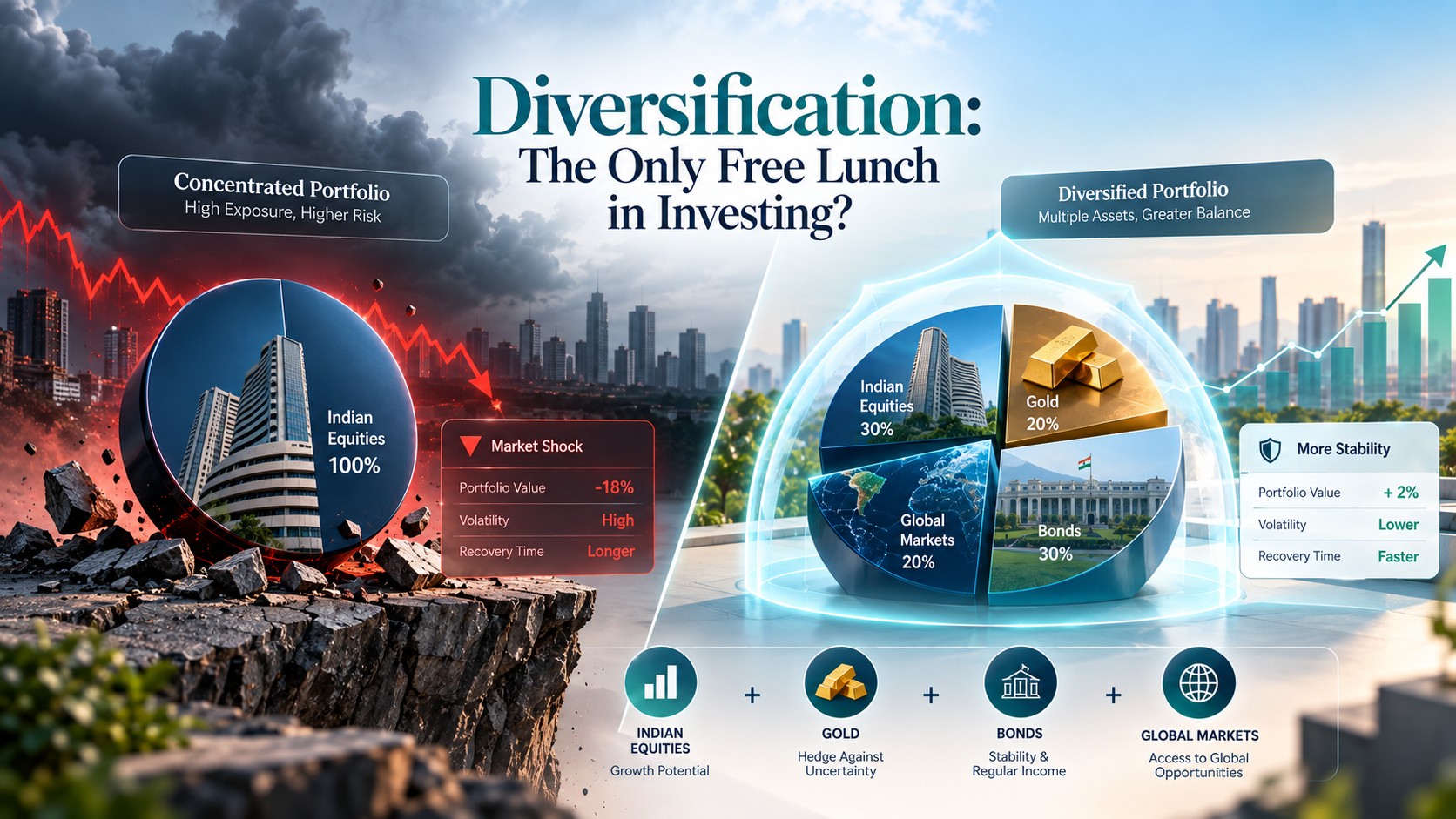
What if you could make your investment portfolio more resilient without having to predict which stock would outperform, when the market would fall, or which sector would lead the next rally?
That is the idea behind diversification.
Often described as the only free lunch in investing, diversification is based on a simple principle: spreading investments across assets that behave differently can help reduce portfolio risk without necessarily sacrificing the potential for returns.
Consider Aarohi, an entrepreneur who built a successful business selling solar-powered equipment. Confident in the sector, she invested most of her personal savings in renewable energy stocks. When policy uncertainty and changing valuations affected the sector, her portfolio suffered alongside her business income.
Her mistake wasn't investing in renewable energy. It was allowing one investment theme to influence too much of her financial future.
This is why diversification remains relevant. It cannot eliminate market risk or guarantee profits, but it can help prevent one wrong bet from determining your entire financial outcome.
What Does Diversification Actually Mean?
Portfolio diversification means spreading investments across different securities, industries, and asset classes instead of depending heavily on a single investment.
The objective is to reduce the impact of any one investment or market segment performing poorly.
A diversified portfolio might include:
-
Equities: For long-term capital growth, with exposure across companies and sectors.
-
Debt instruments: To provide exposure to interest-bearing investments, subject to credit and interest-rate risks.
-
Gold: As an additional asset that may behave differently from equities under certain market conditions.
-
Global investments: To diversify geographically, while introducing currency and overseas market risks.
-
Cash or liquid instruments: For liquidity and near-term financial requirements, depending on the instrument.
The right mix depends on your investment horizon, financial goals, and ability to tolerate losses.
Diversification works because different investments do not always respond to economic events in the same way. When one holding declines, another may hold its value or perform better, cushioning the portfolio's overall movement.
However, diversification is not a guarantee against losses. During periods of severe market stress, investments that usually behave differently can decline together.
Why Is Diversification Called the Only Free Lunch in Investing?
The phrase is associated with economist and Nobel laureate Harry Markowitz, whose work on modern portfolio theory demonstrated the importance of considering risk and return at the portfolio level.
The underlying insight is powerful: you do not necessarily need to increase your expected return to improve the risk characteristics of a portfolio.
Combining investments with different return patterns can reduce overall portfolio volatility compared with holding a concentrated collection of similar investments.
For example, imagine two stocks:
-
Stock A performs strongly when consumer spending rises
-
Stock B belongs to a business whose earnings are influenced by a different set of economic factors
If their prices do not move in perfect synchronisation, combining them may produce a smoother portfolio experience than investing entirely in either one.
The same principle can apply across asset classes.
However, the phrase "free lunch" needs context. Diversification does not mean free profits, zero risk, or guaranteed higher returns. It means that investors may be able to improve the balance between risk and potential return through thoughtful portfolio construction.
The benefit depends on what you own, how those investments behave together, and what you pay to hold them.
The Hidden Risk of Putting Too Much Money in One Place
Concentration risk often develops gradually.
An investor may purchase shares in a company they understand well, receive employer stock as compensation, or repeatedly invest in a sector that has recently performed strongly. Over time, a portfolio that initially looked balanced can become dependent on a single company, industry, or market trend.
Consider Kunal, an industrial designer who received employee stock options from his employer. He also invested his savings in technology stocks because he understood the industry.
His salary, potential stock compensation, and personal portfolio were now linked to the same broad economic theme.
If the technology sector weakened, several parts of his financial life could be affected simultaneously.
This is a form of concentration risk that may not be obvious when investments are considered individually.
What a concentrated portfolio can look like
Suppose an investor has ₹10 lakh invested across five stocks, but ₹7 lakh is concentrated in companies from one industry.
|
Portfolio characteristic |
Amount |
|
Total portfolio |
₹10,00,000 |
|
Exposure to one industry |
₹7,00,000 |
|
Exposure to other industries |
₹3,00,000 |
If the concentrated industry falls by 30%, and the remaining investments stay unchanged, the portfolio loses ₹2.1 lakh.
That is a 21% decline in the total portfolio, even though only one part of the market was affected.
The example assumes the other investments have no price change and ignores taxes and transaction costs. In reality, different holdings may move together or in opposite directions.
The lesson is straightforward: a portfolio can contain multiple investments and still carry substantial concentration risk.
Diversification in Numbers: How Different Outcomes Affect Your Money
Diversification is easier to understand when we examine how losses affect a portfolio.
Imagine two investors, Dev and Leena, each with ₹5 lakh to invest.
Dev places the entire amount in one stock. Leena spreads her money across several companies and asset classes, according to her financial goals and risk tolerance.
Suppose Dev's stock falls 40%.
His ₹5 lakh investment becomes ₹3 lakh.
To return to ₹5 lakh, the remaining ₹3 lakh must grow by approximately 66.7%.
This illustrates an important feature of investment losses: the percentage gain required to recover is larger than the percentage loss incurred.
A diversified portfolio may limit the damage if other investments decline less or perform positively. But the outcome depends on their actual returns; diversification cannot ensure that the portfolio avoids a similar loss.
|
Initial portfolio value |
Loss |
Value after loss |
Gain required to recover |
|
₹5,00,000 |
10% |
₹4,50,000 |
11.1% |
|
₹5,00,000 |
20% |
₹4,00,000 |
25% |
|
₹5,00,000 |
40% |
₹3,00,000 |
66.7% |
This is why risk management matters, even for investors with long-term goals. Avoiding excessive concentration can help protect a portfolio from being disproportionately affected by one adverse outcome.
Why Owning More Investments Does Not Always Mean Better Diversification
Suppose Mira owns six equity mutual funds. She believes her portfolio is diversified because she has invested in multiple schemes.
However, when she checks their holdings, she discovers that several funds own many of the same large-cap companies.
Although Mira owns six funds, she may be repeatedly exposing herself to the same companies and market factors.
This is known as portfolio overlap.
A genuinely diversified portfolio requires more than increasing the number of investments. Investors should examine:
-
Sector exposure: Is too much money concentrated in a particular industry?
-
Stock overlap: Do multiple funds hold the same companies?
-
Asset allocation: Is the portfolio spread across suitable asset classes?
-
Geographic exposure: Does it depend entirely on one country's economy?
-
Risk factors: Are different investments vulnerable to the same economic developments?
For example, investing in an information technology fund, a technology-focused thematic fund, and an equity fund with heavy technology exposure may create less diversification than expected.
Similarly, investing in several equity funds does not provide the same exposure as holding a carefully constructed mix of equities, debt, and other suitable assets.
The goal is not to own more investments. It is to avoid depending excessively on the same source of risk.
Asset Allocation: The Foundation of Diversification
Asset allocation determines how your money is distributed across investment categories.
It is one of the most important decisions in portfolio construction because different asset classes carry different risks and respond differently to changing market conditions.
Consider Rhea, who is saving for two goals: retirement in 25 years and a home renovation in three years.
She should not automatically use the same investment mix for both goals.
Her retirement investments have a longer horizon and may allow her to tolerate greater short-term volatility. The money required for renovation has a much shorter timeline, so protecting its availability becomes more important.
The allocation for each goal should reflect its timeline, required amount, and the consequences of a potential loss.
Diversification should therefore be personalised rather than based on a universal formula.
A practical asset allocation checklist
Before deciding how to distribute your investments, ask:
-
When will I need this money?
-
How much loss could I tolerate without compromising my goal?
-
Do my investments depend too heavily on one company, sector, or asset class?
-
Do I have adequate liquidity for near-term expenses?
-
How often should I review my allocation?
Your allocation can change as your financial circumstances evolve. Regular reviews help identify when your portfolio has drifted away from its intended risk profile.
How 5nance’s AI-powered All Rounder Approaches Diversification
Managing diversification across multiple asset classes requires investors to consider more than individual stock performance. They also need to evaluate broader market trends, asset allocation, and whether the portfolio still reflects their intended risk exposure.
This is where All Rounder by 5nance becomes relevant.
All Rounder is an AI-powered multi-asset investment advisory offering that uses data-driven analysis to help construct and manage portfolios across assets such as stocks, gold, bonds, and global indices.
Its approach includes:
-
Multi-asset exposure: Looking beyond equities to incorporate other asset classes.
-
Dynamic asset allocation: Using market analysis to systematically allocate assets in portfolio.
-
Smart diversification: Considering the role of different investments within the portfolio.
-
Portfolio rebalancing: Adjusting holdings as recommended by the investment process and changing market conditions.
The value of this approach lies in considering investments as parts of a broader portfolio rather than evaluating every holding in isolation.
For example, an investor whose portfolio is heavily influenced by equity market movements may benefit from assessing whether other suitable asset classes could provide a different source of exposure.
However, diversification does not guarantee that losses will be avoided. Gold, bonds, equities, and global investments all carry risks, and their relationships can change over time.
All Rounder should be evaluated against your goals, risk profile, investment horizon, costs, and the product's current terms. AI-assisted allocation is a tool for managing investment decisions, not a promise of superior returns.
8. Rebalancing: Keeping Diversification on Track
Even a well-diversified portfolio can become concentrated over time.
Suppose Aniket starts with a ₹10 lakh portfolio containing 60% equities and 40% other suitable assets.
After a strong equity market rally, his equity holdings increase substantially while the other investments grow more slowly.
His portfolio now has a higher equity allocation than he originally intended.
Although the portfolio has grown, it may also carry more equity risk than Aniket planned to take.
Rebalancing helps bring the portfolio back towards its intended allocation. Depending on the circumstances, this may involve selling part of an overweight investment or directing new contributions towards underweight assets.
Investors should consider taxes, transaction costs, liquidity, and the purpose of each holding before making adjustments.
The aim is not to react to every market movement. It is to keep the portfolio aligned with the investor's financial plan.
For investors who prefer a more structured approach, All Rounder's rebalancing process is designed to respond to portfolio and market conditions. Its current official product information describes automatic rebalancing and dynamic asset allocation.
Diversification Is Not About Predicting the Winner
Investing often encourages people to search for the next winning stock, the best-performing sector, or the asset class that will lead the next rally.
Diversification offers a different approach.
Instead of relying on one prediction being correct, it spreads exposure across investments that may behave differently. It can help manage concentration risk, moderate portfolio fluctuations, and reduce the damage that one adverse event might cause.
But diversification is not simply about owning more stocks or buying multiple mutual funds. It requires thoughtful asset allocation, attention to overlapping holdings, and periodic reviews.
If you want to take a portfolio-level approach to investing, explore how All Rounder by 5nance uses AI-driven analysis, multi-asset exposure, and rebalancing to support a more structured investment process.
Because while no investment strategy can remove uncertainty, a well-diversified portfolio can help ensure that your financial future does not depend on getting every prediction right.
Frequently Asked Questions
1. Why is diversification called the only free lunch in investing?
Diversification can reduce portfolio risk by combining investments that do not move in exactly the same way. It may improve the relationship between risk and potential return without requiring an investor to predict the best-performing investment.
2. Does diversification guarantee profits?
No. Diversification can reduce concentration risk, but it cannot eliminate market risk or guarantee positive returns. Several asset classes can decline simultaneously during periods of market stress.
3. How many stocks are enough for diversification?
There is no universal number. Diversification depends on factors such as company exposure, sector concentration, company size, and the risks affecting individual holdings. Simply owning more stocks does not automatically create a well-diversified portfolio.
4. Are mutual funds automatically diversified?
Not always. Broadly diversified mutual funds can provide exposure to many securities, but sector-specific, thematic, and narrowly focused funds may remain concentrated. Investors should review a fund's holdings and investment objective.
5. What is the difference between diversification and asset allocation?
Asset allocation determines how investments are distributed across asset classes, such as equities, debt, and gold. Diversification involves spreading exposure within and across those categories to avoid excessive dependence on a single investment or source of risk.
6. How often should I rebalance my portfolio?
The appropriate frequency depends on your investment strategy, asset allocation, portfolio changes, and costs. Some investors review at regular intervals, while others use allocation thresholds. Rebalancing should support your financial plan rather than encourage unnecessary trading.
7. How does All Rounder by 5nance support diversification?
All Rounder is an AI-powered multi-asset investment advisory offering that uses data-driven analysis to support allocation across assets such as stocks, gold, bonds, and global indices. It also incorporates portfolio rebalancing. Its suitability depends on an investor's goals, risk profile, costs, and investment horizon.
Sources and References
-
Harry Markowitz — Modern Portfolio Theory.
-
U.S. Securities and Exchange Commission (SEC) — Beginners' Guide to Asset Allocation, Diversification, and Rebalancing.
-
Investor.gov — Asset Allocation and Diversification.
Disclaimer
This article is for educational and informational purposes only and does not constitute investment advice or a recommendation to buy, hold, or sell any security. Investments are subject to market risks, and diversification does not guarantee profits or protect against all losses. Past performance does not guarantee future results. Review your financial goals, investment horizon, risk tolerance, costs, and tax implications before making investment decisions. Consider consulting a SEBI-registered investment adviser for personalised guidance.

