

Large Cap vs Mid Cap vs Small Cap Mutual Funds: Which One Should You Pick in 2026?
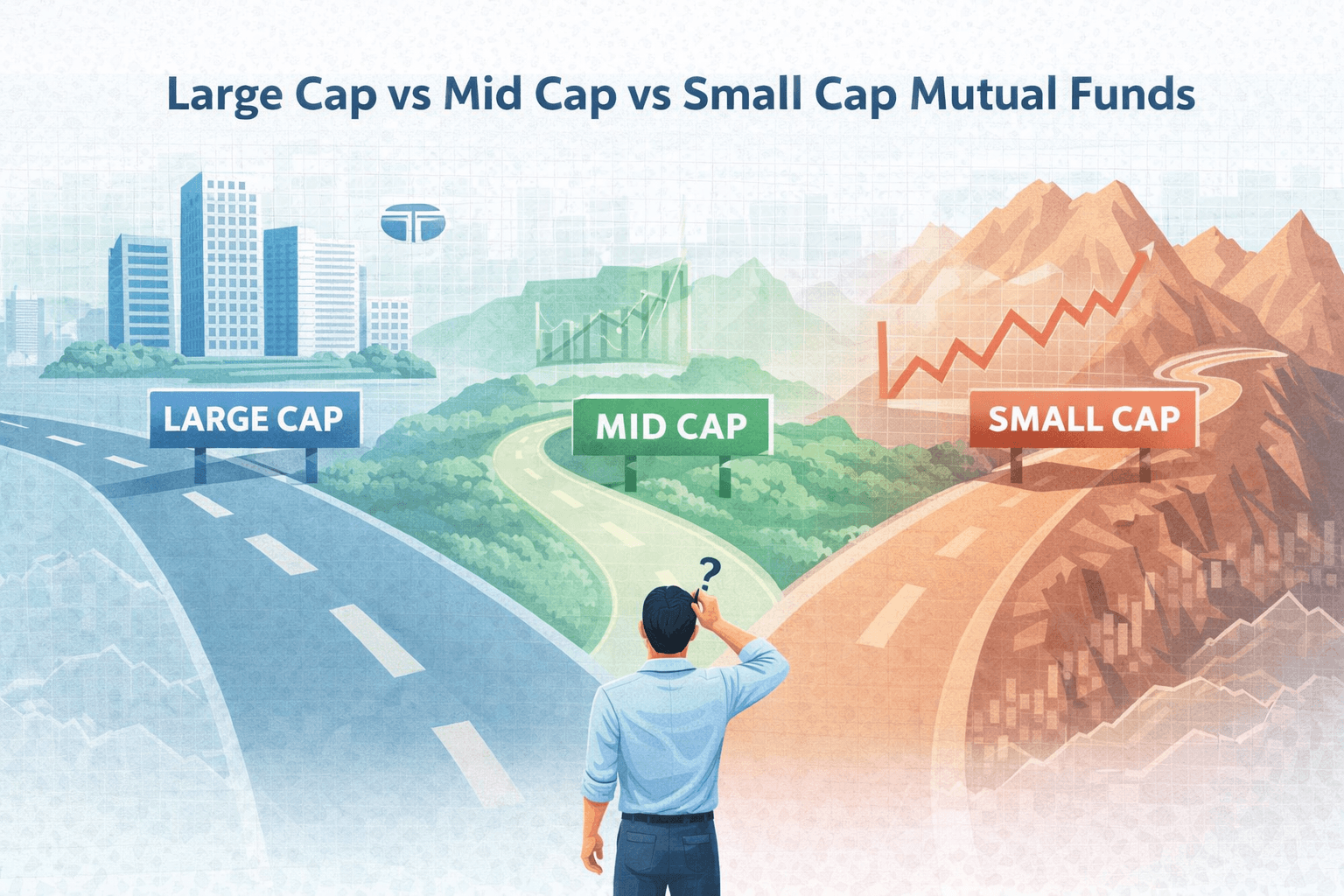
Choosing the right mutual fund category is where many investors get stuck.
Large cap funds feel safer. Mid cap funds seem exciting. Small cap funds promise high growth. But picking the wrong one for your age, goals, or risk appetite can lead to unnecessary stress — or worse, disappointing returns.
The truth is, there is no “best” category for everyone. The right choice depends on how long you can stay invested, how much volatility you can handle, and what you’re investing for.
In this guide, we’ll break down large cap vs mid cap vs small cap mutual funds in simple language, compare them side by side, and help you decide which one fits your financial journey in 2025.
Quick Answers
Choose Large Cap Funds if:
- You are a beginner investor
- You want relatively lower volatility
- Your goal is stable long-term growth
Choose Mid Cap Funds if:
- You want a balance of growth and risk
- You can stay invested for 7+ years
- You are comfortable with moderate volatility
Choose Small Cap Funds if:
- You have a long investment horizon (10+ years)
- You can handle sharp ups and downs
- You want higher growth potential and higher risk
👉 For most investors, the smartest approach is not choosing one — but combining them properly.
What Is a Large Cap Mutual Fund?
A large cap mutual fund invests in the top 100 listed companies by market capitalization.
These are typically well-established businesses like:
- Reliance Industries
- TCS
- HDFC Bank
- Infosys
- ICICI Bank
Large cap companies are generally:
- financially stronger
- more stable
- less volatile than smaller companies
That makes large cap funds a common starting point for beginners.
What Is a Mid Cap Mutual Fund?
A mid cap mutual fund invests in companies ranked roughly 101 to 250 by market capitalization.
These companies are usually:
- growing businesses
- not as established as large caps
- but more mature than small caps
Mid cap funds offer a mix of:
- higher growth potential than large caps
- lower stability than large caps
- moderate-to-high volatility
They are often seen as the “growth engine” in many portfolios.
What Is a Small Cap Mutual Fund?
A small cap mutual fund invests in companies ranked 251 and beyond by market capitalization.
These are smaller businesses with potential to grow significantly over time.
Small cap funds can deliver strong returns, but they also come with:
- higher volatility
- deeper drawdowns during crashes
- longer recovery periods
They are not bad investments — but they demand patience and emotional discipline.
Comparison Framework
| Factor | Large Cap Funds | Mid Cap Funds | Small Cap Funds |
|---|---|---|---|
| Risk | Lower | Moderate to High | High |
| Return Potential | Moderate | High | Very High |
| Volatility | Lower | Medium | Very High |
| Liquidity | High | High | Moderate |
| Best For | Beginners, conservative investors | Growth-focused investors | Aggressive long-term investors |
| Ideal Investment Horizon | 5+ years | 7+ years | 10+ years |
| Downside in Market Crash | Lower | Moderate | Highest |
This is the most important thing to understand:
The higher the return potential, the higher the emotional pain during bad markets.
Real Example: What Happens Over Time?
Let’s assume three investors each invest ₹10,000 per month for 15 years.
We’ll use simple hypothetical average return assumptions:
- Large Cap Fund → 11% annual return
- Mid Cap Fund → 13% annual return
- Small Cap Fund → 15% annual return
Projected Corpus After 15 Years
| Fund Type | Monthly SIP | Assumed Return | Approx Corpus |
|---|---|---|---|
| Large Cap | ₹10,000 | 11% | ₹46 lakh |
| Mid Cap | ₹10,000 | 13% | ₹56 lakh |
| Small Cap | ₹10,000 | 15% | ₹67 lakh |
At first glance, small cap looks like the winner.
But here’s what many investors ignore:
Volatility Scenario
During a market correction:
- Large cap may fall 15–20%
- Mid cap may fall 25–35%
- Small cap may fall 35–50%
Now ask yourself honestly:
Can you continue investing if your portfolio falls 40%?
Because if you panic and stop, the “higher return” advantage disappears.
That’s why category selection is not just about return — it’s about behavioral fit.
What Most Investors Get Wrong
Mistakes Investors Make
1. Choosing Based on Past 1-Year Returns
Many investors buy small cap funds only because they recently gave the highest returns.
That’s dangerous.
Past short-term performance often reflects momentum, not suitability.
2. Ignoring Risk Appetite
A 25-year-old and a 52-year-old should not build the same portfolio.
Risk capacity and emotional tolerance matter.
3. Putting Everything in One Category
Some investors go all-in on small caps during bull markets.
This can backfire badly during corrections.
4. Expecting Mid/Small Caps to Always Outperform
Mid and small cap funds do not outperform every year. They often go through long periods of underperformance and volatility.
5. Stopping SIPs During Market Falls
This is especially common in small cap funds.
Ironically, that’s when long-term investors should stay disciplined.
What Should YOU Do?
This is the most important section.
Because the right category depends on who you are, not just what the market is doing.
If You Are Under 30 → Growth Can Matter More
If you:
- are early in your career
- have 10+ years to invest
- can handle volatility
Then you can consider a portfolio like:
- 40% Large Cap
- 35% Mid Cap
- 25% Small Cap
This gives you growth potential while still maintaining some balance.
If You Are Between 30–45 → Balance Is More Important
At this stage, responsibilities increase:
- home loan
- family expenses
- child planning
- wealth building goals
A more balanced allocation may work better:
- 50% Large Cap
- 30% Mid Cap
- 20% Small Cap
This reduces portfolio stress while still aiming for strong returns.
If You Are Nearing Retirement → Stability Should Lead
If your goal is capital preservation with moderate growth, then aggressive small cap exposure may not be ideal.
A more stable approach may look like:
- 70% Large Cap
- 20% Mid Cap
- 10% Small Cap
Or even lower equity risk depending on your overall asset allocation.
Psychological Trigger Section
The biggest mistake in investing is not choosing the “wrong” category once.
It’s staying misaligned for years.
A fund category that looks exciting on paper can become painful in real life if it makes you panic during volatility.
And once you stop investing or redeem in fear, compounding gets interrupted.
The real goal is not to maximize return in theory.
It is to build a portfolio you can actually stick with for 10–15 years.
So Should You Pick One or Combine Them?
For most investors, choosing only one category is unnecessary.
A combination usually works better because:
- Large cap brings stability
- Mid cap brings growth
- Small cap brings long-term upside
This creates a more balanced equity portfolio.
But here’s the catch:
Managing this manually can get confusing.
Because then you have to decide:
- how much to allocate to each
- when to rebalance
- when to reduce risk
- whether market conditions have changed
Soft Bridge to Portfolio Solution
This is why many investors today prefer structured or AI-assisted portfolio strategies instead of manually choosing and rebalancing mutual fund categories themselves.
A smart allocation framework can help:
- reduce overexposure to risky segments
- improve discipline
- align funds to your risk profile and goals
- adjust based on changing market conditions
Instead of chasing categories, the focus shifts to building a portfolio that actually works for your life.
What Should You Do Next?
Step 1: Decide your investment horizon
If your goal is less than 5 years away, aggressive small cap exposure may not be suitable.
Step 2: Assess your risk honestly
Can you emotionally handle deep temporary losses?
Step 3: Choose allocation, not just category
Think in percentages, not “best fund” headlines.
Step 4: Stay disciplined through cycles
The category matters — but your consistency matters more.
If you don’t want to manage category selection and rebalancing manually, consider using a structured portfolio approach that does this intelligently.
FAQ
1. Which is better: large cap, mid cap, or small cap mutual funds?
There is no universal winner. Large cap is better for stability, mid cap for balanced growth, and small cap for aggressive long-term investing.
2. Can I invest in all three categories together?
Yes — and for most investors, that’s often a smarter strategy than choosing only one.
3. Are small cap mutual funds risky?
Yes, small cap funds are significantly more volatile than large cap and mid cap funds. They are suitable only for long-term investors who can tolerate sharp corrections.
4. Which mutual fund category is best for beginners?
Large cap mutual funds are generally more beginner-friendly due to lower volatility and stronger underlying companies.
5. How long should I stay invested in mid cap and small cap funds?
Mid cap funds usually need at least 7 years, while small cap funds are best suited for 10+ year horizons.
6. Should I stop SIP in small cap funds when the market falls?
Not necessarily. If your goal and time horizon remain long term, market corrections often create better buying opportunities.


