

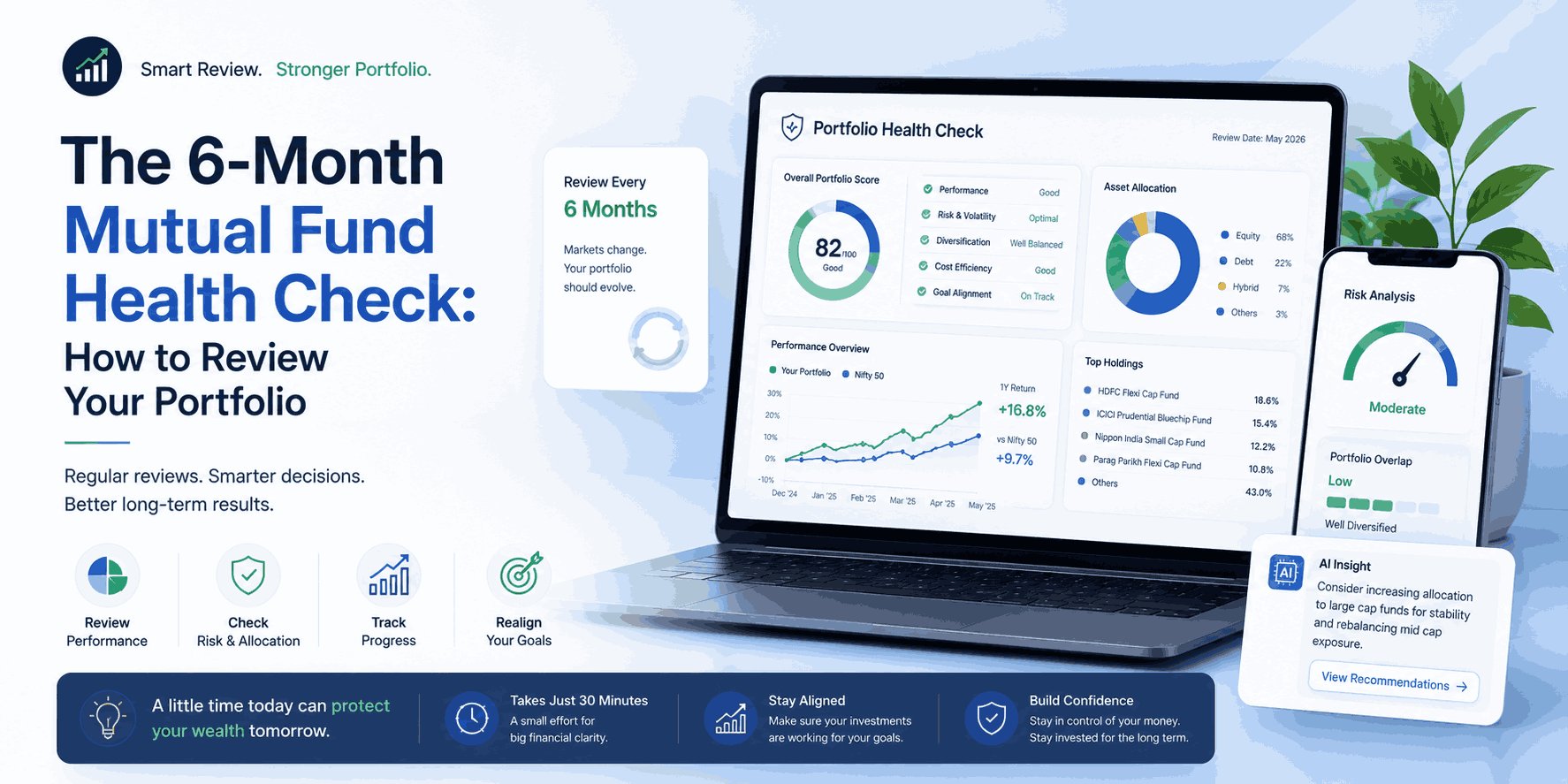
The 6-Month Mutual Fund Health Check: How to Review Your Portfolio
Let's start with a simple question.
When was the last time you reviewed your mutual fund portfolio?
If your answer is "I check the returns every now and then," you're not alone.
Most investors spend days researching the "best mutual fund" before investing. They compare returns, ratings, expense ratios, and even watch hours of YouTube videos. But once the SIP starts, the portfolio quietly moves into the background.
Months pass.
Markets change.
Fund managers change.
Your financial goals evolve.
Yet your investments often stay exactly where they were.
Here's the interesting part.
Successful investing isn't about constantly changing your portfolio. It's about knowing when you don't need to—and when you absolutely do.
That's why financial planners recommend reviewing your mutual fund portfolio at least once every six months.
Not to chase the next top-performing fund.
But to make sure your money is still working toward the life you're building.
Why a Portfolio Review Matters More Than You Think
Imagine you've planned a road trip from Mumbai to Goa.
Halfway through, a bridge closes, traffic builds up, and a faster highway opens nearby.
Would you continue on the old route simply because that's what you originally planned?
Probably not.
Investing works the same way.
A portfolio review isn't about changing your destination.
It's about making sure you're still taking the best route to get there.
According to AMFI (Association of Mutual Funds in India), the Indian mutual fund industry crossed ₹72 lakh crore in Assets Under Management (AUM) in 2025, reflecting record participation from retail investors. Yet many investors rarely review whether their portfolios still align with their financial goals.
Source: AMFI India
The irony?
Millions of people invest consistently through SIPs but don't spend even 30 minutes twice a year reviewing those investments.
Let's fix that.
1. Ask Yourself: Is This Fund Still Helping Me Reach My Goal?
This sounds obvious.
But it's the question most investors forget to ask.
Maybe you invested in a mid-cap fund five years ago because you wanted aggressive growth.
Today?
You've bought a house.
Started a family.
Or you're just five years away from retirement.
Your financial priorities have changed.
Has your portfolio changed with them?
Every mutual fund should have a clear purpose.
Ask yourself:
- Why did I buy this fund?
- Does it still fit my financial goals?
- Would I invest in this same fund if I were starting today?
If the answer is "no," it might be time to reconsider—not because the fund is bad, but because your life has changed.
2. Don't Chase Returns. Compare Performance the Right Way.
Here's one of the biggest investing mistakes.
People switch mutual funds after one bad year.
But one year's performance tells you very little.
Instead, compare your fund against:
- Its benchmark index
- Similar funds in the same category
- Its own 3-year and 5-year performance
A fund that slightly underperforms for a few months isn't necessarily a poor investment.
Markets move in cycles.
Consistency matters far more than short-term outperformance.
As legendary investor Warren Buffett famously said:
"The stock market is a device for transferring money from the impatient to the patient."
The same principle applies to mutual funds.
3. Your Best Performing Fund Might Be Increasing Your Risk
This surprises most investors.
Let's say you started with this allocation:
- 70% Equity
- 30% Debt
Over the last two years, equity markets perform exceptionally well.
Without doing anything, your portfolio now looks like this:
- 84% Equity
- 16% Debt
Sounds great.
Except your portfolio is now significantly riskier than you originally intended.
This is called portfolio drift, and it happens more often than people realize.
A six-month review helps you rebalance your investments and bring your risk back under control.
Think of it as servicing your car before a long journey—not because something is broken, but because you want everything running smoothly.
4. Are You Really Diversified?
Owning multiple mutual funds doesn't automatically mean you're diversified.
Here's an example.
Imagine you own:
- Large Cap Fund A
- Flexi Cap Fund B
- ELSS Fund C
- Multi Cap Fund D
Looks diversified.
But after reviewing the portfolio, you discover all four funds have significant exposure to companies like:
- HDFC Bank
- Reliance Industries
- Infosys
- ICICI Bank
- TCS
Different fund names.
Nearly identical holdings.
This is known as portfolio overlap, and it quietly reduces the diversification you're expecting.
A good review helps identify whether your funds are genuinely complementing each other—or simply duplicating the same investments.
5. Has Your Risk Appetite Changed?
Life rarely stays the same for six months.
You may have:
- Changed jobs
- Received a salary hike
- Started a business
- Had a child
- Planned a major purchase
Each of these changes affects how much investment risk you can comfortably take.
The portfolio that suited you at 25 may not be the right one at 35.
Reviewing your investments regularly ensures your portfolio evolves as your life evolves.
6. Check the Costs You're Paying
Returns matter.
But so do costs.
Even a small difference in expense ratio can affect your long-term wealth.
While reviewing your portfolio, look at:
- Expense Ratio
- Exit Load
- Tax implications of switching funds
Remember:
Higher cost doesn't always mean better performance.
Sometimes a lower-cost fund delivering similar returns can improve your overall portfolio efficiency.
7. Is Every Fund Doing a Job?
Every investment should earn its place in your portfolio.
Think of your portfolio like a cricket team.
You wouldn't pick eleven opening batsmen.
You need specialists.
Similarly:
- Large Cap Funds provide stability.
- Mid Cap Funds focus on growth.
- Debt Funds reduce volatility.
- Gold acts as a hedge during uncertainty.
If two funds are performing the exact same role, one of them may be unnecessary.
Simplifying your portfolio often makes it stronger—not weaker.
8. Here's What Humans Miss (And AI Doesn't)
Let's be honest.
Most of us don't wake up thinking,
"I should check whether my portfolio has drifted 8% from its target allocation."
Life gets busy.
That's where technology changes the game.
Traditional portfolio reviews happen every six months.
AI-powered portfolio reviews happen every day.
Instead of checking returns occasionally, AI can continuously monitor:
- Portfolio drift
- Asset allocation
- Fund overlap
- Market volatility
- Risk exposure
- Performance consistency
Rather than reacting after something changes, AI helps identify potential issues before they become bigger problems.
This is exactly the philosophy behind 5nance's AI-powered portfolio solutions.
Instead of expecting investors to monitor dozens of funds manually, intelligent algorithms continuously evaluate portfolios and suggest changes only when they're actually needed.
It's not about replacing human judgment.
It's about making better decisions with better information.
Common Portfolio Review Mistakes Investors Make
Before you finish reviewing your investments, avoid these common traps:
❌ Switching funds after one bad month
❌ Investing in too many similar funds
❌ Looking only at returns
❌ Ignoring changes in personal financial goals
❌ Forgetting to rebalance asset allocation
❌ Making emotional decisions during market volatility
Remember, a portfolio review is meant to improve your long-term strategy—not encourage unnecessary buying and selling.
Final Thoughts: Review Your Portfolio, Not Your Emotions
One of the biggest myths in investing is that successful investors constantly buy and sell.
They don't.
They review.
They rebalance.
They stay disciplined.
As author Morgan Housel writes in The Psychology of Money:
"Doing well with money has little to do with how smart you are and a lot to do with how you behave."
That's exactly why portfolio reviews matter.
Not because the market demands action every six months.
But because your financial life is constantly evolving.
Spending just half an hour reviewing your mutual fund portfolio twice a year could help you identify hidden risks, remove unnecessary overlap, improve diversification, and stay aligned with your long-term goals.
And if you don't have the time—or simply don't enjoy tracking markets—AI-powered portfolio monitoring can do much of the heavy lifting for you.
At 5nance, our AI-driven investment solutions are designed to continuously monitor portfolios, adapt to changing market conditions, and help investors stay on track without making emotionally driven decisions.
Because the goal isn't just to invest.
It's to keep investing smarter, every step of the way.


