

How to Avoid Mutual Fund Overlap: A Simple Guide to Building a Smarter Portfolio
Investing in mutual funds is one of the easiest ways to build long-term wealth. You start a SIP, choose a few well-rated funds, and let compounding do the rest.
Sounds simple, right?
But there is one mistake many investors make without realizing it: Mutual Fund Overlap.
You may own multiple “good” mutual funds and still end up with a portfolio that behaves like a single fund.
That means:
- Your diversification is weaker than you think.
- Your risk is higher than it appears.
- Your returns may be lower than expected.
If you’ve ever wondered why your portfolio is not performing despite investing in top-rated funds, overlap could be the reason.
In this guide, you’ll learn what mutual fund overlap is, why it matters, and how to avoid it.
What Is Mutual Fund Overlap?
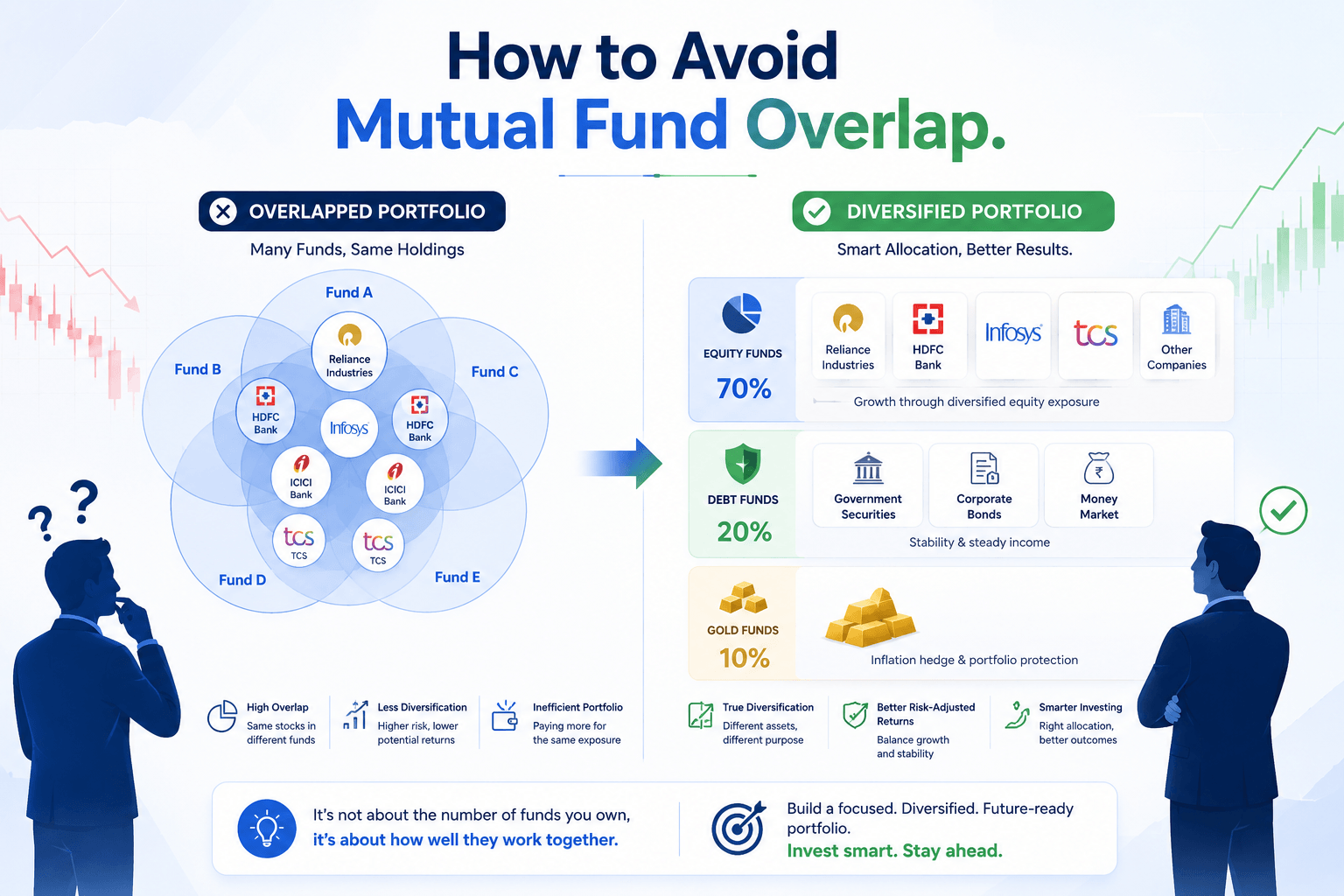
Mutual fund overlap happens when two or more funds in your portfolio hold many of the same stocks.
For example, imagine you invest in:
- A large-cap fund
- A flexi-cap fund
- An ELSS fund
At first glance, this looks diversified.
But if all three funds own stocks like:
- Reliance Industries
- HDFC Bank
- Infosys
- ICICI Bank
- TCS
then you’re effectively investing in the same companies multiple times.
This is mutual fund overlap.
Why Mutual Fund Overlap Is a Problem
Overlap doesn’t necessarily mean your portfolio will perform badly. The problem is that it reduces the benefit of diversification.
1. Higher Concentration Risk
If several funds hold the same stocks, your portfolio becomes heavily dependent on a few companies.
If those stocks underperform, your entire portfolio suffers.
2. Lower Diversification
Owning five funds may feel diversified, but if they hold similar stocks, your actual diversification is limited.
3. Unnecessary Complexity
Tracking multiple funds becomes difficult when they are all doing the same thing.
4. Diluted Returns
Too many overlapping funds can lead to average returns instead of meaningful outperformance.
How Common Is Mutual Fund Overlap?
Very common.
India has over 2,500 mutual fund schemes across categories. With so many choices, investors often pick funds based on recent returns, ratings, or recommendations from friends.
The result?
Portfolios with:
- 6 to 10 funds
- Significant duplication
- No clear asset allocation strategy
A report by the Association of Mutual Funds in India (AMFI) shows that retail participation continues to grow rapidly, with SIP contributions consistently above ₹20,000 crore per month in recent years. As more investors enter the market, portfolio overlap has become one of the most overlooked issues in personal finance.
Real-Life Example of Mutual Fund Overlap
Suppose your portfolio includes:
- Large Cap Fund A
- Flexi Cap Fund B
- ELSS Fund C
- Index Fund D
Each fund is highly rated.
However, after checking the top 10 holdings, you find that:
- Reliance Industries appears in all four funds
- HDFC Bank appears in all four funds
- ICICI Bank appears in three funds
- Infosys appears in all four funds
So while you own four funds, your money is heavily concentrated in the same stocks.
That is the illusion of diversification.
How Much Overlap Is Acceptable?
Some overlap is normal.
Large-cap funds, for example, often own similar blue-chip stocks because they invest in the same universe.
As a rule of thumb:
- Below 20% overlap: generally acceptable
- 20% to 40% overlap: review carefully
- Above 40% overlap: consider simplifying
The goal is not to eliminate overlap entirely, but to ensure each fund adds something different to your portfolio.
How to Check Mutual Fund Overlap
You can analyze overlap by comparing the top holdings of your funds.
Many investment platforms and research websites provide overlap tools that show:
- Common holdings
- Percentage overlap
- Category concentration
You can also manually compare fact sheets if you prefer.
When reviewing overlap, focus on:
- Top 10 holdings
- Sector exposure
- Market-cap allocation
Signs Your Portfolio Has Too Much Overlap
You may have excessive overlap if:
- You own more than 5–6 Mutual Funds.
- Several funds belong to similar categories.
- Your returns closely mirror a single index.
- You struggle to explain why each fund is in your portfolio.
- Your top holdings repeat across multiple funds.
How to Avoid Mutual Fund Overlap
1. Start With Asset Allocation
Before choosing funds, decide how much to allocate to:
- Equity
- Debt
- Gold
- Cash or liquid funds
Asset allocation has a bigger impact on long-term outcomes than fund selection alone.
2. Limit the Number of Funds
For most investors, 4 to 6 well-chosen funds are more than enough.
A simple portfolio might include:
- One large-cap or index fund
- One flexi-cap or multi-cap fund
- One mid-cap fund
- One debt fund
- Optional gold allocation
3. Avoid Buying Similar Categories Repeatedly
Holding two large-cap funds rarely adds much value.
Instead, choose funds with distinct roles.
4. Review Holdings, Not Just Ratings
A 5-star rating doesn’t tell you whether a fund overlaps with what you already own.
5. Rebalance Periodically
Review and Rebalance your portfolio at least once a year to ensure allocations remain aligned with your goals.
Portfolio Construction Matters More Than Picking “Best Funds”
Many investors focus on finding the best-performing mutual fund.
But investing success depends more on:
- Asset allocation
- Diversification
- Cost control
- Consistency
- Rebalancing
A portfolio of average funds arranged intelligently can often outperform a collection of top-rated funds chosen randomly.
Example: Overlapping Portfolio vs Structured Portfolio
Overlapping Portfolio
- 2 large-cap funds
- 2 flexi-cap funds
- 1 ELSS fund
- 1 index fund
Result:
- Significant duplication
- Similar performance across funds
- Higher concentration risk
Structured Portfolio
- 1 index fund
- 1 flexi-cap fund
- 1 mid-cap fund
- 1 short-duration debt fund
- 1 gold fund (optional)
Result:
- Clear role for each fund
- Better diversification
- Easier to monitor
How AI Helps Reduce Mutual Fund Overlap
Manually analyzing holdings across multiple funds can be time-consuming.
This is where technology can help.
Algrow by 5nance
5nance’s Algrow uses AI to analyze Mutual Funds and identify stronger alternatives based on data-driven insights. It helps investors move away from underperforming or redundant fund choices.
Common Mistakes Investors Make
Chasing Recent Winners
Buying last year’s top-performing fund often leads to disappointment.
Owning Too Many Funds
More funds do not automatically mean better diversification.
Ignoring Asset Allocation
Diversification across asset classes matters more than the number of funds.
Never Reviewing the Portfolio
Markets change, and portfolios should evolve too.
When Overlap May Be Acceptable
Overlap is not always bad.
It can be acceptable when:
- You intentionally want higher exposure to a specific sector or stock.
- You are transitioning from one fund to another.
- The overlap is limited and aligns with your strategy.
The key is to be intentional.
Final Thoughts
Mutual fund overlap is one of the most common reasons investors feel disappointed with their portfolio performance.
You may be investing regularly and selecting highly rated funds, but if those funds hold the same stocks, your portfolio may not be as diversified as you think.
The solution is straightforward:
- Focus on portfolio construction, not just individual funds.
- Keep the number of funds manageable.
- Check for overlap regularly.
- Build a clear Asset Allocation Strategy.
A well-structured portfolio is easier to manage, less stressful to hold, and more likely to help you achieve your financial goals.
What Should You Do Next?
Review your current portfolio and ask yourself:
- Why do I own each fund?
- Do these funds overlap significantly?
- Is my Asset Allocation aligned with my goals?
If the answers are unclear, your portfolio may need a closer look.
Sometimes, the best improvement you can make is not adding another mutual fund — it’s simplifying the ones you already own.
Get a professionally constructed Diversified Mutual Fund Portfolio with MF Baskets.
Download The 5nance AI App


