

How Ready-Made MF Portfolios Work: A Simple Guide for Investors
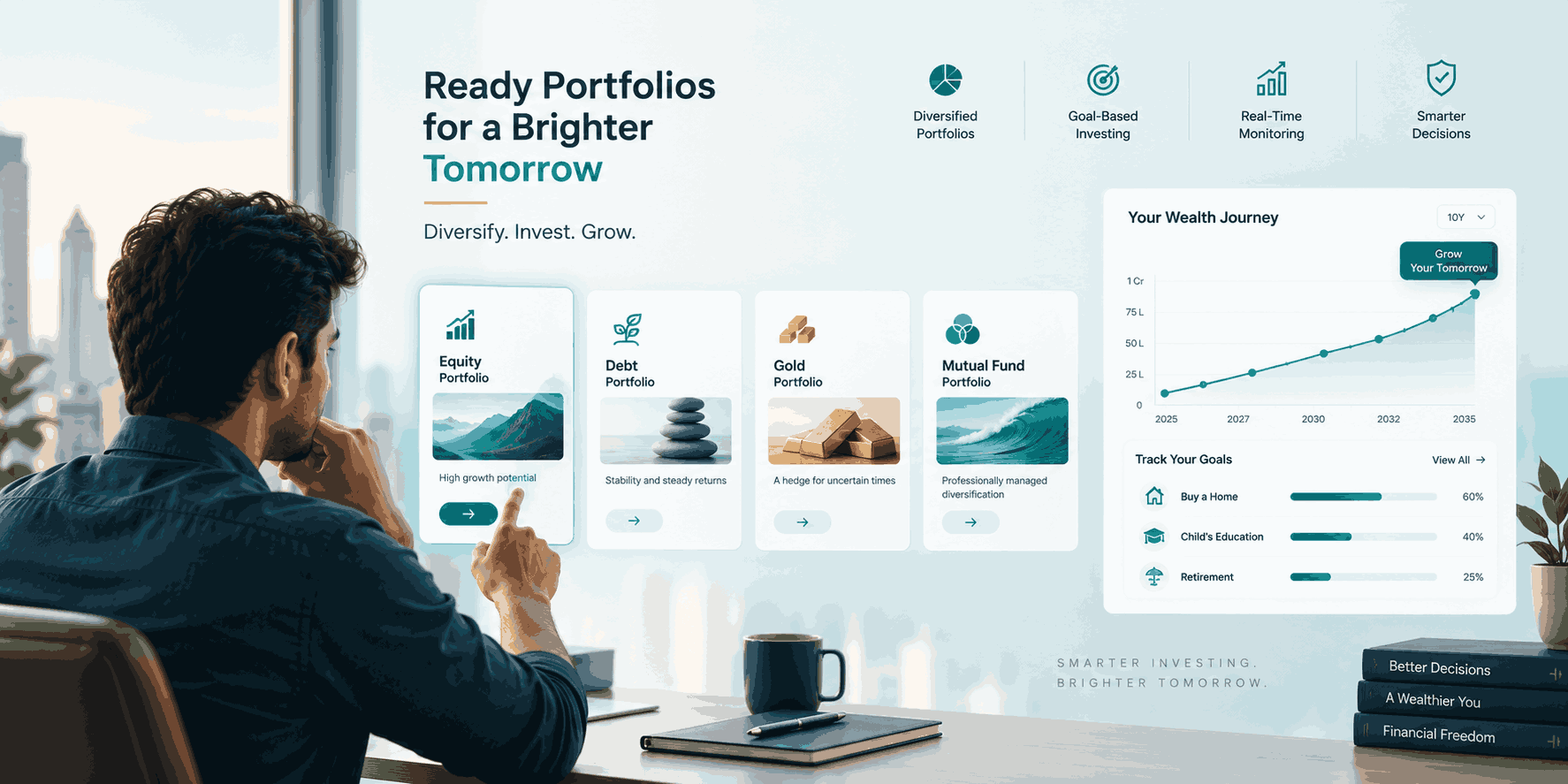
Imagine you have ₹5 lakh ready to invest.
You know you don't want the money sitting idle. You also know that putting the entire amount into one stock may not be sensible.
So you start researching.
One mutual fund has delivered strong returns.
Another has a lower expense ratio.
A third is recommended by a friend.
Then you start comparing fund categories, risk levels, portfolio holdings, past performance and investment strategies.
A few hours later, you have 15 tabs open, and still don't know what to buy.
This is one of the problems ready-made MF portfolios are designed to address.
Instead of asking an investor to build a portfolio security by security or fund by fund, a ready-made portfolio brings a pre-selected collection of investments together around a defined objective, strategy or risk profile.
But what exactly does that mean?
How do ready-made MF portfolios work?
Who should consider them?
And are they actually better than building your own portfolio?
Let's break it down.
What Is a Ready-Made MF Portfolio?
A ready-made MF portfolio is a pre-constructed collection of investments designed around a particular objective, investment strategy or risk profile.
Rather than selecting every investment independently, an investor chooses a portfolio that has already been structured.
For example, a hypothetical growth-oriented portfolio could contain:
-
Large-cap equity exposure
-
Mid-cap equity exposure
-
Debt allocation
-
Gold allocation
The investor doesn't have to separately decide how much to put into each component before getting started.
The exact investments, allocation and management process depend on the provider and the portfolio strategy.
This is different from simply buying one mutual fund.
A mutual fund is itself a professionally managed investment scheme. A ready-made portfolio can bring multiple investments or schemes together into a broader portfolio structure.
AMFI notes that Mutual Funds themselves offer professional management and diversification across securities and asset categories, which is one reason they are widely used as building blocks for investor portfolios.
Why Do Ready-Made MF Portfolios Exist?
The biggest problem isn't always lack of investment options.
It can be the opposite.
There are thousands of mutual fund schemes, stocks, ETFs and other investment products available to investors.
More choice sounds helpful.
But more choice can also create decision fatigue.
Consider Ananya, a 29-year-old product designer.
She wants to invest ₹20,000 every month.
She has shortlisted:
-
6 equity mutual funds
-
3 hybrid funds
-
2 index funds
-
4 ETFs
Her problem isn't finding an investment.
Her problem is deciding:
Which ones belong together?
And once she invests, another question appears:
When should I change them?
A ready-made portfolio attempts to solve the second problem as well as the first by giving the investor a structured portfolio rather than a collection of unrelated investment choices.
How Do Ready-Made MF Portfolios Work?
The process is generally straightforward.
Step 1: Identify the Investment Objective
The portfolio begins with a specific purpose.
It could focus on:
-
Long-term wealth creation
-
Retirement
-
Capital Preservation
-
Income
-
Balanced growth
-
A particular Risk Profile
The objective determines what investments may be included.
Step 2: Select the Investments
The portfolio creator evaluates potential investments based on criteria such as:
-
Investment objective
-
Risk
-
Historical behaviour
-
Portfolio construction
-
Cost
-
Diversification
-
Investment horizon
The exact methodology varies between providers.
Step 3: Construct the Portfolio
The selected investments are combined into a portfolio.
For example, a hypothetical balanced portfolio could look like:
|
Asset |
Allocation |
|
Equity Mutual Funds |
60% |
|
Debt Mutual Funds |
25% |
|
Gold |
10% |
|
Cash/Liquid Allocation |
5% |
Instead of deciding these percentages independently, the investor starts with a predefined structure.
Step 4: Invest
The investor invests according to the portfolio's minimum investment requirement or contribution structure.
For someone investing through SIPs, the portfolio can also become a systematic part of their monthly investing routine.
AMFI describes SIPs as a methodology through which investors invest a fixed amount periodically in a mutual fund scheme, helping create an automated and disciplined investment process.
Step 5: Monitor and Rebalance
This is an important distinction.
A portfolio isn't necessarily "ready-made" only because someone selected the investments once.
A well-designed portfolio may also have a process for reviewing allocations and rebalancing when required.
For example, suppose a portfolio starts with:
60% Equity + 30% Debt + 10% Gold
After a strong equity rally, it becomes:
72% Equity + 20% Debt + 8% Gold
The portfolio may now carry more equity risk than originally intended.
Rebalancing can bring it closer to the target allocation.
SEBI's investor education material identifies asset allocation as one strategy for diversification and risk management.
A Ready-Made MF Portfolio Is Not the Same as a Single Mutual Fund
This differentiation is important.
Suppose you invest ₹1 lakh in an equity mutual fund.
The fund manager decides which securities to buy and sell within that scheme according to its mandate.
You own units of that mutual fund.
Now consider a ready-made portfolio containing:
-
Equity Fund A
-
Equity Fund B
-
Debt Fund C
-
Gold Fund D
Here, the portfolio is helping determine how your overall investment is distributed across multiple holdings or schemes.
The mutual funds manage the investments within their individual mandates.
The portfolio strategy manages the combination.
Think of the distinction as:
Mutual Fund → manages an investment scheme
Ready-Made MF Portfolio → structures multiple investments around an overall strategy
The two can work together.
Who Are Ready-Made MF Portfolios For?
Ready-made MF Portfolios can be particularly useful for investors who:
Are New to Investing
You don't need to become an expert in fund selection before starting.
Have Limited Time
You may understand investing but simply don't have the time to research dozens of schemes.
Want Diversification
You want exposure to multiple investments without manually constructing everything.
Struggle With Portfolio Decisions
Choosing investments may be easy.
Knowing what to remove later can be much harder.
Want a Structured Approach
Instead of investing randomly every month, you want your money to follow a defined strategy.
A Real-World Example: From 11 Funds to One Strategy
Consider Vikram, a 36-year-old entrepreneur.
Over five years, he accumulated 11 mutual funds.
He didn't intentionally create a complicated portfolio.
He simply invested whenever someone recommended something interesting.
His portfolio eventually looked like this:
-
4 large-cap funds
-
2 flexi-cap funds
-
2 mid-cap funds
-
1 small-cap fund
-
1 hybrid fund
-
1 thematic fund
At first glance, 11 funds appear diversified.
But when he examines the underlying holdings, he discovers that several funds own many of the same large companies.
His portfolio has more schemes but not necessarily, proportionally more diversification.
A curated portfolio approach could help him think about the portfolio from the top down:
What should my overall asset allocation be?
Then:
Which investments should represent each part of that allocation?
That shift from collecting investments to constructing a portfolio is one of the key ideas behind ready-made portfolios.
Are Ready-Made MF Portfolios Only for Beginners?
No.
In fact, experienced investors can take more advantage from them.
A sophisticated investor may understand markets very well but still prefer a structured portfolio because they don't want to spend weekends reviewing 20 funds.
For example, Nikhil, a senior technology executive, has ₹80 lakh invested.
He understands equity markets and follows financial news regularly.
But his portfolio management process has become increasingly time-consuming.
He doesn't need someone to explain what a mutual fund is.
He needs a repeatable framework for managing his overall investments.
For investors like Nikhil, convenience and portfolio discipline may be more valuable than basic investment education.
What Are the Benefits of Ready-Made MF Portfolios?
1. Less Research
You don't have to start your investment journey with hundreds of options.
2. Better Structure
Investments are selected as part of a broader portfolio rather than in isolation.
3. Diversification
A portfolio can spread exposure across multiple securities, schemes or asset classes.
4. Easier Decision-Making
Instead of asking "Which of these 30 funds should I buy?", the investor starts with a smaller set of structured choices.
5. Easier Portfolio Monitoring
If the portfolio has a defined strategy, reviewing whether it is still aligned with that strategy becomes easier.
6. More Investment Discipline
A structured portfolio can reduce the temptation to continuously jump between investments based on short-term market movements.
AMFI identifies diversification, professional management, affordability and convenience among the key advantages associated with mutual funds.
What Are the Limitations?
Ready-made doesn't mean risk-free.
A portfolio can be thoughtfully constructed and still lose money.
Market Risk
If the underlying investments fall, the portfolio value can decline.
No Guaranteed Returns
Historical performance cannot guarantee future results. AMFI explicitly states that mutual fund returns are not guaranteed and that investors should consider their objectives, risk appetite and circumstances.
Not Automatically Suitable for Everyone
A portfolio designed for aggressive growth may be unsuitable for someone who needs the money in two years.
One Size Should Not Mean One Portfolio
Even within a ready-made approach, investors should choose based on their own goals, risk tolerance and investment horizon.
Monitoring Still Matters
A ready-made portfolio doesn't mean "invest and forget forever."
Your circumstances can change.
Your goals can change.
The market environment can change.
Your portfolio should be reviewed accordingly.
Ready-Made MF Portfolios vs Building Your Own Portfolio
Which approach is better?
It depends on how involved you want to be.
|
Factor |
DIY Portfolio |
Ready-Made MF Portfolio |
|
Fund selection |
Investor decides |
Pre-selected |
|
Asset allocation |
Investor decides |
Strategy-driven |
|
Research required |
Higher |
Lower |
|
Flexibility |
Very high |
Depends on portfolio |
|
Monitoring |
Investor's responsibility |
Structured process |
|
Diversification |
Depends on investor |
Built into strategy |
|
Suitable for |
Hands-on investors |
Investors seeking convenience |
Neither approach is universally superior.
A financially knowledgeable investor who enjoys portfolio management may prefer DIY investing.
Someone who wants a more structured and convenient approach may prefer a ready-made portfolio.
Where Do MF Baskets Fit In?
This is where MF Baskets can be particularly relevant.
MF Baskets by 5nance are professionally curated portfolios of Direct Mutual Funds, designed around different investment objectives and risk profiles.
Instead of selecting individual mutual funds from the entire universe of available schemes, an investor can explore a portfolio that has already been structured around a particular objective.
This can simplify three important decisions:
What should I invest in?
How should the investments fit together?
How do I build a more structured mutual fund portfolio?
For investors who prefer mutual funds as the core of their portfolio, MF Baskets provide a ready-made starting point rather than requiring them to build the entire portfolio from scratch.
Why Direct Mutual Funds Matter in MF Baskets
MF Baskets use Direct Mutual Funds.
SEBI requires mutual funds to offer direct plans alongside regular plans. Direct plans are not routed through distributors and therefore have lower expense ratios because distribution-related expenses and commissions are not included in the same way as in regular plans.
That difference can matter over long investment periods because costs also compound.
A Simple Illustration
Suppose two otherwise similar investment approaches have an annual cost difference.
You might barely notice the difference in the first year.
But if the investment remains invested for 10, 15 or 20 years, the opportunity cost can become meaningful because the money spent on expenses is money that is no longer compounding.
This is why investors should look beyond just the headline return and consider cost, portfolio construction, and suitability.
Example: How MF Baskets Can Simplify a ₹15,000 SIP
Let's take Sana, a 31-year-old marketing professional.
She has ₹15,000 available every month for long-term wealth creation.
Instead of selecting five or six mutual funds independently, she chooses a suitable MF Basket aligned with her objective and risk profile.
Her monthly investment becomes part of a predefined portfolio structure.
The benefit isn't that the portfolio guarantees a better return.
The benefit is that Sana no longer has to make every fund-selection decision from scratch.
She can focus on:
Invest → Monitor → Review → Stay invested
rather than:
Search → Compare → Second-guess → Switch → Repeat
That distinction can be valuable for investors who find the investment-selection process overwhelming.
Ready-Made MF Portfolios vs Investing in One "Best" Fund
One of the most common mistakes investors make is searching for the single best mutual fund.
But a portfolio isn't necessarily designed to identify one winner.
Suppose Fund A delivers 18% while Fund B delivers 13%.
Choosing only Fund A because it performed better last year may seem logical.
But what if Fund A carries significantly higher volatility?
Or what if Fund B provides exposure that complements another part of your portfolio?
A portfolio approach asks a different question:
“How do these investments work together?”
That's often more useful than asking:
“Which investment performed best?”
Can Ready-Made MF Portfolios Help With Goal-Based Investing?
Yes, provided the portfolio's risk profile and investment horizon match the goal.
Consider three investors:
Aarav — New Car in 2 Years
He needs capital stability.
An aggressive equity-heavy portfolio may not be appropriate for money required so soon.
Diya — Home Purchase in 8 Years
She has more time and may be able to tolerate greater market exposure.
Kabir — Retirement in 25 Years
His long horizon may allow substantially higher exposure to growth-oriented investments, subject to his risk tolerance.
The same ready-made portfolio should not automatically be used for all three.
The portfolio should follow the goal, not the other way around.
What Should You Check Before Choosing a Ready-Made MF Portfolio?
Don't choose a portfolio simply because its name sounds attractive.
Check:
1. Investment Objective
What is the portfolio actually trying to achieve?
2. Risk Level
Does the risk suit your financial situation?
3. Asset Allocation
Where is your money actually being invested?
4. Underlying Investments
What funds or securities make up the portfolio?
5. Costs
Understand the applicable advisory, portfolio or fund-level costs.
6. Rebalancing Method
Is the portfolio reviewed periodically?
7. Investment Horizon
How long should you realistically remain invested?
8. Track Record and Methodology
Understand how the portfolio is constructed rather than relying only on past returns.
SEBI and AMFI both emphasise that investors should consider risk, objectives and suitability rather than treating historical performance as a guarantee of future results.
Who Should Consider MF Baskets?
MF Baskets can be particularly relevant for investors who:
-
Want mutual funds but don't want to research hundreds of schemes.
-
Prefer a professionally curated portfolio.
-
Want Direct Mutual Fund exposure.
-
Want investments organised around specific objectives or risk profiles.
-
Prefer a structured portfolio over selecting funds individually.
They may be less suitable for investors who enjoy selecting and managing every individual fund themselves or have highly specific portfolio requirements that don't match an available basket.
Why Choose Ready-Made MF Portfolios?
The decision can be surprisingly simple.
Consider a ready-made portfolio if:
-
You find fund selection overwhelming.
-
You don't have time for regular research.
-
You want a predefined investment strategy.
-
You want diversification without constructing everything yourself.
-
You prefer a more systematic investing process.
There is no prize for making investing unnecessarily complicated.
Frequently Asked Questions
What is a ready-made MF portfolio?
A ready-made portfolio is a pre-constructed collection of investments designed around a specific objective, strategy or risk profile. It allows investors to choose a structured portfolio rather than selecting every investment independently.
Are ready-made MF portfolios safe?
No investment portfolio is completely risk-free. The risk depends on the underlying investments and asset allocation. Investors should choose a portfolio based on their goals, time horizon and risk tolerance.
Are ready-made MF portfolios better than mutual funds?
They serve different purposes. A mutual fund is an individual professionally managed investment scheme, while a ready-made portfolio can combine multiple investments or schemes into a broader strategy.
Are MF Baskets ready-made MF portfolios?
Yes. MF Baskets are professionally curated portfolios of Direct Mutual Funds designed around investment objectives and risk profiles.
Can I invest in MF Baskets through SIP?
If the specific basket and platform support systematic investing, investors can use recurring contributions to build their portfolio over time. The applicable minimums and terms should be checked before investing.
Do ready-made MF portfolios guarantee returns?
No. Market-linked investments do not guarantee returns. Past performance is not a guarantee of future results.
Are Direct Mutual Funds better than Regular Mutual Funds?
Direct and regular plans of the same mutual fund scheme have the same underlying portfolio and are managed by the same fund manager, but direct plans have lower expense ratios because they do not include distributor-related expenses.
The Bottom Line: Ready-Made Doesn't Mean Thoughtless
Investing doesn't have to mean choosing from an endless list of funds.
A ready-made portfolio gives investors a starting structure.
It brings together investments according to a defined strategy, making it easier to think about the portfolio as a whole rather than individual investments in isolation.
But convenience shouldn't replace understanding.
Before choosing a ready-made portfolio, ask:
What is this portfolio designed for?
What risks am I taking?
What am I paying?
Does it fit my financial goal and investment horizon?
If the answers make sense, a ready-made portfolio can turn a complicated investment-selection process into a much more manageable one.
And for investors looking specifically for curated mutual fund portfolios, MF Baskets can provide a structured way to invest in Direct Mutual Funds without having to build the portfolio entirely from scratch.
Ready to Simplify Your Mutual Fund Investing?
You don't need to research hundreds of mutual fund schemes to start building a portfolio.
With 5nance MF Baskets, you can explore professionally curated portfolios of Direct Mutual Funds designed around different investment objectives and risk profiles.
Less time choosing individual funds. More focus on building a portfolio that fits your goals.
Explore MF Baskets
Start with a portfolio designed around your investment objective—not a random collection of funds.


