

ETFs vs Mutual Funds: Understanding the Difference and Choosing What’s Right for You
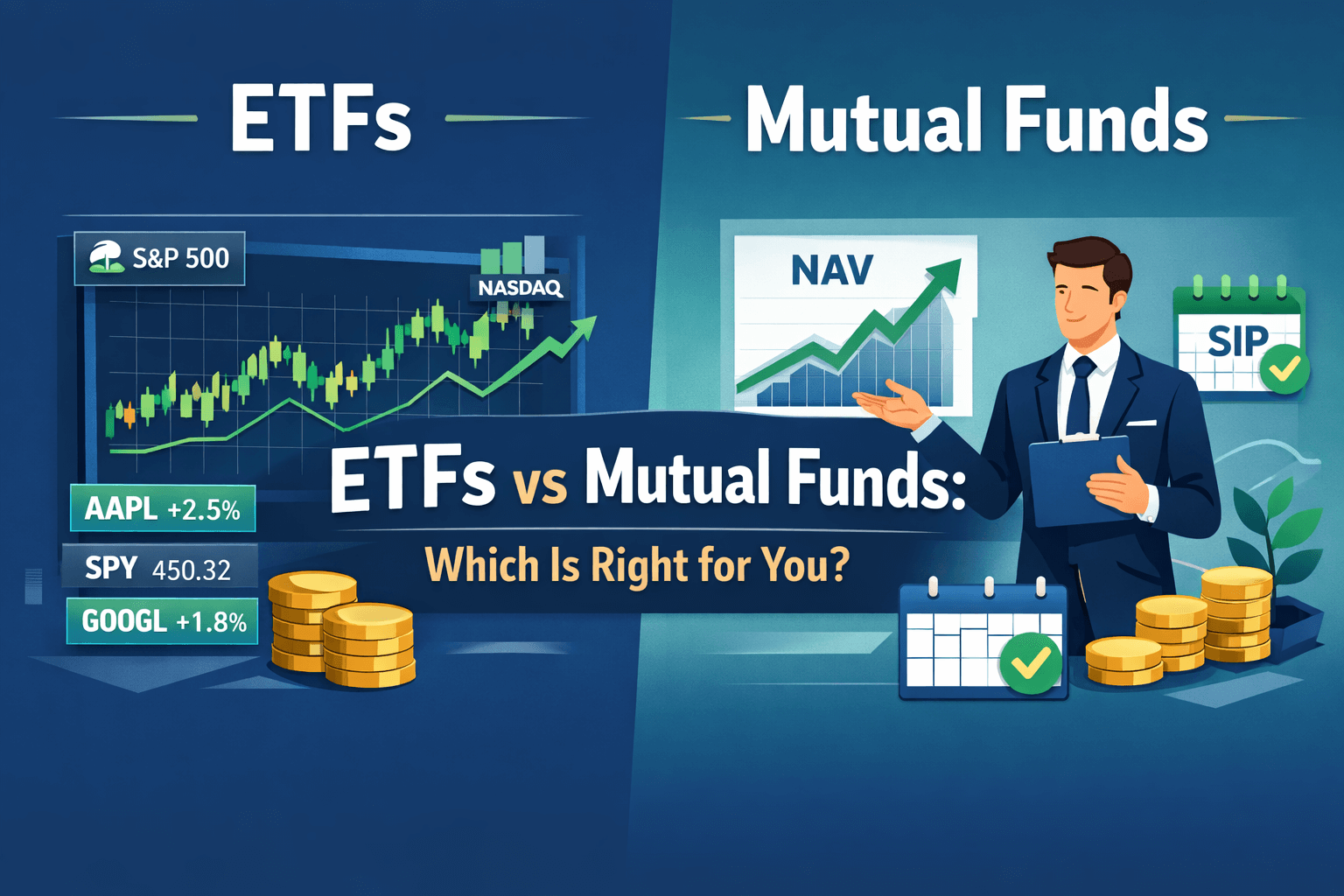
When it comes to investing, two names often dominate the conversation—Exchange-Traded Funds (ETFs) and Mutual Funds. Both are widely used by investors across the world and are often recommended as solid options for long-term wealth creation.
At first glance, ETFs and mutual funds look quite similar. After all, both pool money from multiple investors and invest in a diversified set of assets like stocks, bonds, commodities, or other securities. However, the way they function, how they are bought and sold, and how investors experience them are quite different.
If you’ve ever wondered “Should I invest in ETFs or mutual funds?”, this guide will help you understand the differences clearly—without jargon—and decide what fits your investing style and goals best.
What Are ETFs and Mutual Funds?
Exchange-Traded Funds (ETFs)
ETFs are investment funds that are listed and traded on stock exchanges, just like shares. Each ETF represents a basket of securities—such as stocks, bonds, gold, or other assets—usually designed to track a specific index or theme.
Because ETFs trade on exchanges, their prices change throughout the trading day, based on market demand and supply.
Mutual Funds
Mutual funds, on the other hand, are bought and sold directly through fund houses or platforms. When you place an order, the transaction is executed at the Net Asset Value (NAV), which is calculated at the end of the trading day.
Unlike ETFs, you cannot trade mutual funds during market hours. The transaction is processed once a day, and units typically reflect in your account within T+1 or T+2 working days.
The Core Difference: How ETFs and Mutual Funds Are Traded
This is the most important distinction between the two:
-
ETFs can be traded anytime during market hours, just like stocks. You can buy or sell them at real-time prices.
-
Mutual Funds can only be bought or sold at the end-of-day NAV, regardless of when you place the order.
In short:
-
ETFs offer intra-day liquidity
-
Mutual funds offer end-of-day execution
Despite this difference, both ETFs and mutual funds can be excellent tools for long-term investing when used correctly.
ETFs and Mutual Funds: A Look at Market Growth
Both investment vehicles have grown rapidly over the years:
-
The global ETF market has crossed $9 trillion in Assets Under Management (AUM).
-
The global mutual fund industry stands at approximately $59 trillion in AUM.
(Source: Public domain industry data)
In India, mutual funds continue to dominate retail investing—especially through SIPs—while ETFs are gaining popularity among cost-conscious and index-focused investors.
Benefits of Investing in Exchange-Traded Funds (ETFs)
ETFs are often preferred by investors who like transparency, flexibility, and low costs.
1. Intra-Day Liquidity
ETFs can be bought or sold at any point during market hours. This gives investors the ability to respond quickly to market movements if needed.
2. Lower Expense Ratios
Most ETFs are passively managed, meaning they simply track an index instead of trying to beat it. This reduces fund management and administrative costs, resulting in lower expense ratios compared to many mutual funds.
3. Transparency
ETF holdings are usually disclosed daily. You know exactly what assets the ETF holds at any given time.
4. Wide Range of Investment Options
ETFs are available across:
-
Broad market indices (Nifty 50, Sensex)
-
Sectoral themes (IT, Banking, Pharma)
-
Commodities (Gold ETFs)
-
Bonds and debt instruments
-
International markets
5. No Fixed Minimum Investment
There is generally no minimum investment requirement for ETFs. You can buy even a single unit, making them accessible to small investors. Many brokers also offer commission-free ETF trading.
6. Trading Flexibility
Since ETFs trade like stocks, investors can use limit orders, observe price movements, and apply tactical strategies if they wish.
Benefits of Investing in Mutual Funds
Mutual funds remain the most popular choice for Indian retail investors—and for good reason.
1. Simplicity and Ease
Mutual funds are ideal for investors who prefer a hands-off approach. You invest, and professional fund managers handle the research, selection, and monitoring.
2. SIP-Based Discipline
Systematic Investment Plans (SIPs) allow you to invest small amounts—starting as low as ₹500—on a regular basis. This helps build discipline and reduces the stress of market timing.
3. Active Fund Management
Most mutual funds in India are actively managed. Fund managers actively buy and sell securities with the goal of outperforming the market.
4. No Intra-Day Noise
Since transactions happen only at NAV, mutual fund investors are less tempted to react to daily market volatility, which can help avoid emotional decisions.
5. Wide Variety of Strategies
Mutual funds offer:
-
Equity funds
-
Debt funds
-
Hybrid funds
-
ELSS (tax-saving funds)
-
Sectoral and thematic funds
This variety makes it easier to match funds to specific financial goals.
ETFs vs Mutual Funds: A Simple Comparison
| Aspect | ETFs | Mutual Funds |
|---|---|---|
| Trading | Intra-day on exchange | Once a day at NAV |
| Pricing | Market-driven | End-of-day NAV |
| Management | Mostly passive | Mostly active |
| Costs | Generally lower | Generally higher |
| Minimum Investment | One unit | SIP from ₹500 |
| Ideal For | DIY investors | Goal-based investors |
Which One Is Better for Long-Term Investing?
There’s no universal winner.
-
ETFs work well for investors who want low-cost, index-based exposure and are comfortable with market mechanics.
-
Mutual funds suit investors who want professional management, SIP convenience, and goal-based planning.
Many experienced investors use both ETFs and mutual funds together to build a diversified portfolio.
Common Misconceptions to Avoid
-
“ETFs are only for traders” – Not true. ETFs are widely used for long-term investing globally.
-
“Mutual funds are expensive” – While some funds have higher costs, many offer value through active management.
-
“One is better than the other” – The right choice depends on your goals, not the product alone.
Things to Consider Before Investing
Before choosing between ETFs and mutual funds, ask yourself:
-
Do I want active or passive management?
-
Am I comfortable tracking markets?
-
Do I prefer SIP-based investing?
-
What are my financial goals and time horizon?
Your answers will guide the decision more effectively than performance comparisons alone.
Final Thoughts
ETFs and Mutual Funds are not rivals—they are different tools designed for different investing styles.
-
ETFs offer flexibility, transparency, and low costs.
-
Mutual funds offer simplicity, discipline, and professional expertise.
The smartest approach is not choosing one over the other blindly, but using them strategically based on your needs.
When aligned with your goals and risk profile, both ETFs and Mutual Funds can help you build long-term wealth.
Disclaimer
Mutual Fund and ETF investments are subject to market risks. Please read all scheme-related documents carefully before investing.


