

Equity Market vs Mutual Funds: Where Should Beginners Start?
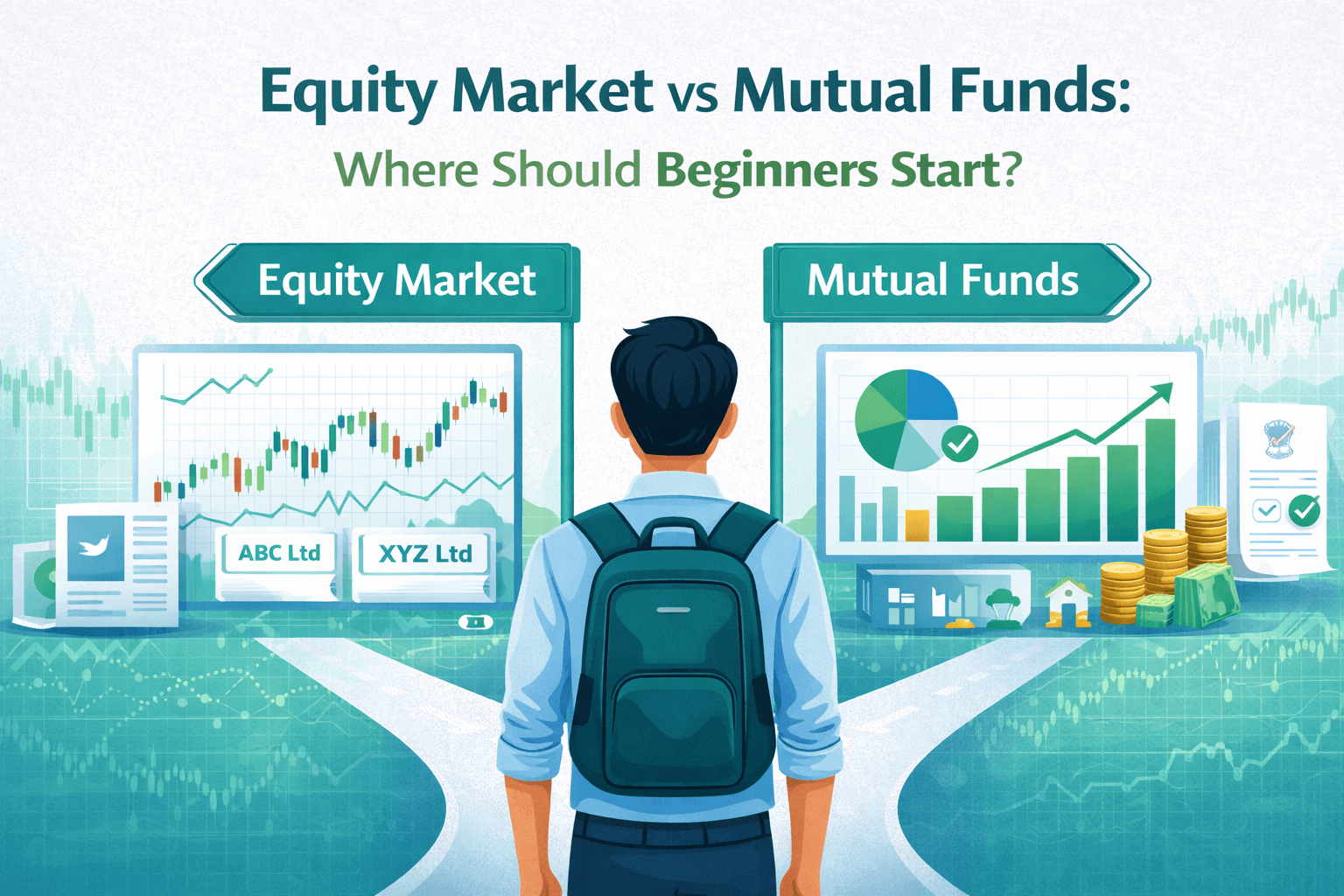
If you’re new to investing, this is probably your first big question:
Should I invest directly in the Equity Market, or start with Mutual Funds?
It’s a fair question. Both can help you grow your money. Both invest in companies. Both carry market risk. But they work very differently — especially for beginners.
And choosing the wrong starting point can either build your confidence… or completely discourage you.
Let’s break this down simply, honestly, and practically — so you can make a decision that fits you, not just what everyone else is doing.
First, What Do We Mean by Equity Market?
When someone says they’re investing in the equity market, they usually mean:
-
Buying individual stocks (like Reliance, TCS, Infosys, HDFC Bank)
-
Selecting companies themselves
-
Deciding when to buy and when to sell
-
Managing everything independently
You open a demat account, research stocks, and directly own shares of companies.
Sounds empowering, right? It is — but it also comes with responsibility.
What Are Mutual Funds Then?
Mutual funds pool money from many investors and invest in:
-
Stocks
-
Bonds
-
Or a mix of both
Instead of picking individual stocks yourself, a fund manager does it for you.
You invest through:
-
SIP (Systematic Investment Plan)
-
Lump sum
-
Regular contributions
You don’t select 15–20 stocks. The fund already holds a diversified basket.
The Core Difference (In One Line)
Equity investing = You are the decision-maker.
Mutual funds = A professional manages decisions for you.
Now let’s go deeper.
Knowledge Required: Be Honest With Yourself
Direct Equity
If you invest directly in stocks, you need to:
-
Understand financial statements
-
Read quarterly results
-
Track industry trends
-
Monitor valuations
-
Stay updated with news
You don’t just “buy good companies.” You need to know why they are good — and whether they’re overpriced.
For beginners, this can be overwhelming.
Mutual Funds
With mutual funds:
-
Research burden reduces
-
Portfolio already diversified
-
Professional management included
-
Risk spread across many companies
For someone starting out, this makes the process smoother and less intimidating.
Risk Level: How Much Can You Handle?
Direct Equity Risk
Let’s say you invest ₹50,000 into 3 stocks.
If one performs badly, 30–40% of your capital could get impacted.
Stock-specific risk is real:
-
Management scandals
-
Regulatory issues
-
Earnings misses
-
Sector downturns
And beginners often panic during market corrections.
Mutual Fund Risk
A typical equity mutual fund may hold 40–70 stocks.
Even if one stock performs poorly:
-
The impact is limited
-
Portfolio absorbs shocks better
-
Risk is distributed
For beginners, this reduces emotional stress.
Time Commitment: Do You Have It?
Direct Equity Needs:
-
Regular monitoring
-
Reading market news
-
Tracking results
-
Portfolio rebalancing
If you work full-time, managing stocks actively can feel like a second job.
Mutual Funds Need:
-
Periodic review (once every few months)
-
Minimal daily monitoring
-
Automated SIPs possible
If you don’t have time to track markets daily, mutual funds are easier.
Return Potential: Is Equity Always Higher?
Many beginners assume:
“Direct stocks give higher returns than mutual funds.”
Not necessarily.
Yes, if you:
-
Pick the right stocks
-
Enter at the right time
-
Exit at the right time
-
Stay disciplined
But that’s easier said than done.
Data shows that a large percentage of retail investors underperform markets due to:
-
Emotional buying
-
Panic selling
-
Chasing trends
-
Overconfidence
Mutual funds, especially well-managed ones, often deliver competitive long-term returns without requiring constant action.
Emotional Discipline: The Silent Factor
This is where most beginners fail.
In direct equity:
-
Market falls 15% → panic
-
Friend makes profit → FOMO
-
Stock rallies → greed
-
News breaks → impulsive selling
Mutual funds reduce emotional damage because:
-
You don’t see stock-level volatility
-
SIP builds discipline
-
Diversification lowers extreme swings
For beginners, emotional control matters more than stock selection.
So Where Should Beginners Start?
Let’s answer directly.
If you are:
-
New to investing
-
Earning a salary
-
Unsure about stock analysis
-
Busy with work
-
Risk-sensitive
Start with mutual funds.
Build:
-
Investing habit
-
Market understanding
-
Risk tolerance
-
Discipline
Later, once confident, you can allocate a portion to direct equity.
A Smarter Middle Path: Managed & AI-Assisted Investing
Now here’s something beginners don’t realize:
Even mutual funds can become confusing.
There are:
-
2,000+ schemes
-
Large cap, mid cap, small cap
-
Hybrid, debt, sectoral
-
Direct vs regular plans
-
Growth vs dividend
Choosing the wrong fund can hurt returns just like picking the wrong stock.
This is where technology changes the game.
Instead of:
-
Guessing funds
-
Relying on tips
-
Following past returns blindly
You can use AI-powered Mutual Fund Advisory.
For example, platforms like Algrow use data-driven systems to:
-
Analyze market conditions
-
Select suitable mutual funds
-
Switch allocations when required
-
Reduce emotional decisions
-
Align investments with risk profile
For beginners, this removes confusion.
You don’t just “buy a fund.”
You follow a structured strategy.
What About Costs?
Direct Equity
-
Brokerage charges
-
STT
-
Slippage
-
Time cost (hidden but real)
Mutual Funds
-
Expense ratio
-
Exit load (if applicable)
But here’s the key:
The biggest cost is wrong decisions, not fees.
Example Scenario
Let’s say you earn ₹30,000/month and can invest ₹5,000.
Option 1: Direct Equity
You buy:
-
2 trending stocks
-
Without diversification
-
Without deep research
One correct move makes you confident.
One wrong move discourages you completely.
Option 2: Mutual Fund SIP
You invest ₹5,000/month in a diversified equity fund.
Over time:
-
You build habit
-
Benefit from Rupee Cost Averaging
-
Stay invested during ups and downs
-
Learn without major damage
For beginners, habit > heroics.
Common Mistakes Beginners Make
-
Starting with stock tips
-
Investing lump sum in trending stocks
-
Ignoring diversification
-
Stopping SIP during market fall
-
Trying to time the market
Whether you choose equity or mutual funds, avoiding these mistakes matters more than chasing maximum returns.
We have published a detailed blog on the following topic: Common Mistakes Begineers make while Investing.
Final Verdict: Start Smart, Then Scale
There’s nothing wrong with direct equity.
But it requires:
-
Knowledge
-
Time
-
Emotional maturity
-
Risk appetite
Mutual funds provide:
-
Structure
-
Professional management
-
Beginner-friendly entry
For most first-time investors, mutual funds are the safer and smarter starting point.
And if you want to remove confusion further, using a data-driven, AI-backed advisory model can make the journey smoother.
Investing is not about proving you’re smart.
It’s about staying consistent long enough for compounding to work.
Conclusion: Focus on the Journey, Not Just the Starting Point
The real question isn’t:
“Equity or mutual funds?”
The real question is:
“Can I stay invested consistently for 10–15 years?”
If mutual funds help you do that — start there.
You can always explore direct equity later once your foundation is strong.
Remember:
Wealth is built through discipline, not drama.


