

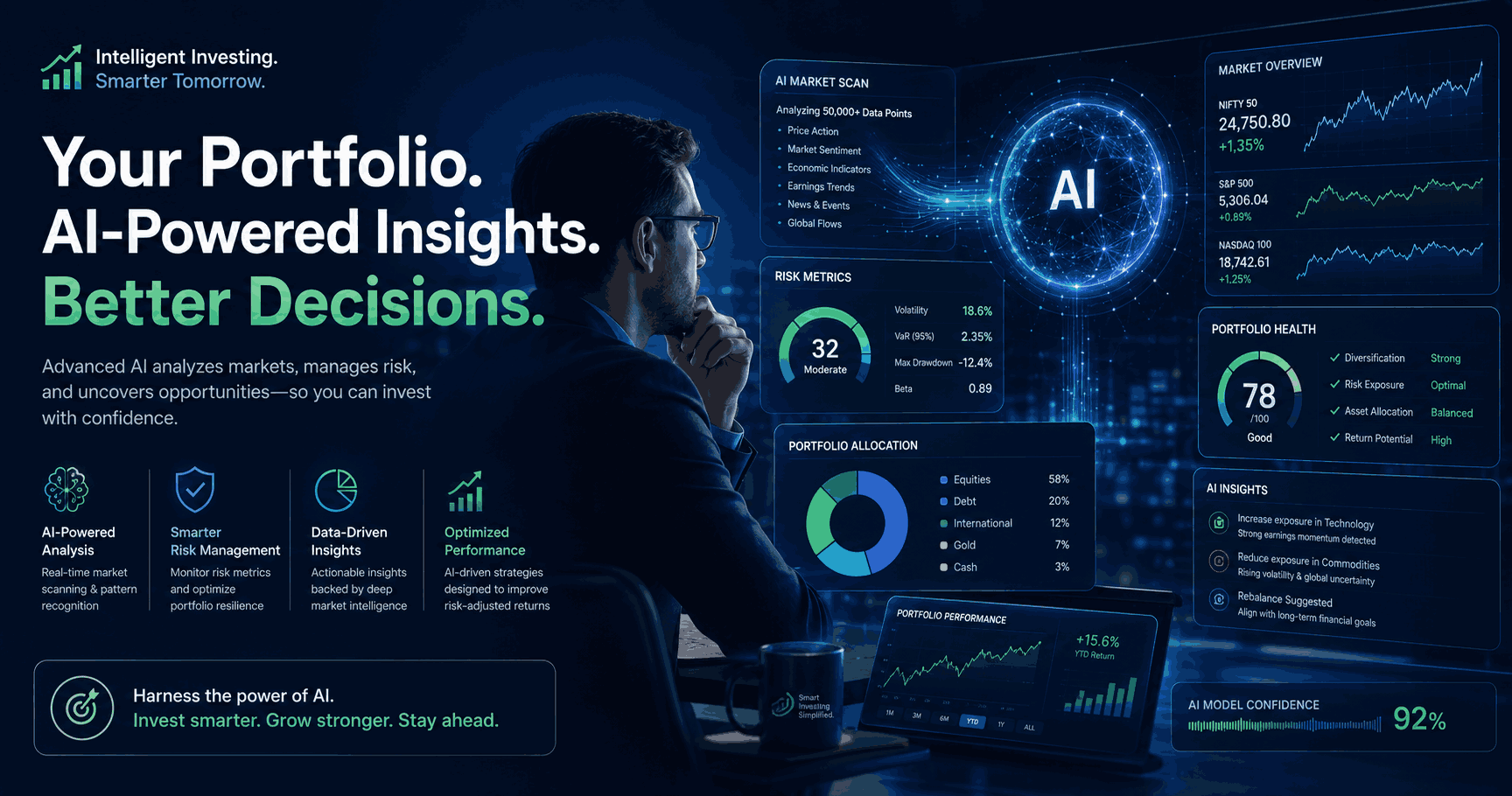
Can AI Help Investors Make Better Decisions?
Investing has never been easier.
Today, anyone with a smartphone can:
-
Open a demat account
-
Buy stocks
-
Invest in mutual funds
-
Track portfolios in real time
Yet despite having access to more information than ever before, many investors continue to struggle with one critical challenge:
Making good investment decisions consistently.
Markets are driven not only by numbers but also by human emotions.
- Fear during market crashes.
- Greed during bull runs.
- Overconfidence after a few successful investments.
- Panic when volatility increases.
These emotional reactions often lead investors to make poor decisions at exactly the wrong time.
This is where Artificial Intelligence (AI) is beginning to change the investing landscape.
From portfolio construction and stock screening to risk management and asset allocation, AI is increasingly being used to help investors make more objective and data-driven decisions.
But can AI actually help investors make better decisions?
Or is it simply another investing buzzword?
In this blog, we'll explore:
-
How AI is transforming investing
-
The biggest mistakes investors make
-
Where AI adds value
-
The limitations of AI investing
-
Real-world examples of AI-driven investment strategies
Most importantly, we'll answer whether AI can genuinely improve investment outcomes.
Why Investors Often Make Poor Decisions
Before understanding AI, it's important to understand the biggest challenge in investing:
Human behavior.
Research in behavioral finance has repeatedly shown that investors often underperform not because of bad investments, but because of bad decisions.
Common investing mistakes include:
-
Buying after markets have already surged
-
Selling during market crashes
-
Chasing recent winners
-
Ignoring risk
-
Holding losing investments too long
-
Frequently switching strategies
Even highly educated investors are not immune to these biases.
The problem isn't lack of information.
The problem is how humans react to information.
The Emotional Cost of Investing
Consider a common scenario.
Markets decline by 15%.
News channels begin predicting further corrections.
Social media becomes filled with negative sentiment.
Many investors panic and sell.
Months later, markets recover and move higher.
The investor then re-enters at higher levels.
This cycle repeats repeatedly across market cycles.
The result:
-
Buy high
-
Sell low
-
Destroy long-term returns
This is one of the reasons many investors fail to achieve the returns generated by the investments they own.
What Is AI based Investing?
AI investing refers to the use of artificial intelligence, machine learning, and advanced algorithms to assist investment decision-making.
Unlike traditional investing approaches that depend heavily on human judgment, AI systems can analyze:
-
Massive amounts of market data
-
Company fundamentals
-
Technical indicators
-
Economic trends
-
Historical patterns
-
Risk factors
And do so continuously.
The goal is simple:
Make investment decisions based on data rather than emotions.
How AI Helps Investors Make Better Decisions
1. Eliminating Emotional Bias
One of AI's biggest advantages is that it has no emotions.
AI doesn't:
-
Panic during crashes
-
Get greedy during rallies
-
Follow market rumors
-
React to headlines emotionally
Instead, it follows predefined rules and data-driven models.
This helps create more disciplined investment decisions.
Example
Suppose markets fall 20%.
A human investor may panic and exit investments.
An AI model may identify the correction as an opportunity to rebalance or accumulate quality assets based on predefined signals.
This can improve long-term outcomes.
2. Processing Huge Volumes of Data
The average investor can only analyze a limited amount of information.
AI can process:
-
Thousands of stocks
-
Financial statements
-
Earnings reports
-
Market trends
-
Price movements
-
Risk indicators
simultaneously.
This allows AI systems to identify patterns that may be difficult for humans to detect.
3. Consistent Portfolio Monitoring
Many investors review portfolios only occasionally.
AI systems can monitor portfolios continuously.
They can identify:
-
Portfolio drift
-
Risk concentration
-
Sector overexposure
-
Asset allocation imbalances
before they become significant issues.
This allows for more proactive portfolio management.
How AI Is Being Used in Modern Investing
AI is no longer limited to hedge funds and institutional investors.
Today, AI-driven investing solutions are becoming increasingly accessible to retail investors.
Some common applications include:
Stock Selection
Identifying companies that meet predefined criteria.
Portfolio Construction
Building diversified portfolios based on risk and return objectives.
Asset Allocation
Determining the ideal mix of equity, debt, and alternative assets.
Risk Management
Monitoring downside risk and portfolio volatility.
Portfolio Rebalancing
Adjusting investments when allocations deviate from target levels.
Example: AI in Portfolio Rebalancing
Let's assume an investor starts with:
|
Asset Class |
Allocation |
|
Equity |
70% |
|
Debt |
20% |
|
Gold |
10% |
After a strong bull market, equity rises to 85%.
Many investors ignore the change.
An AI system may automatically identify the drift and recommend rebalancing back toward the intended allocation.
This helps maintain the desired risk profile.
Can AI Help Investors Avoid Common Mistakes?
In many cases, yes.
AI can help reduce mistakes such as:
Chasing Recent Winners
Many investors buy investments solely because they recently performed well.
AI models typically evaluate broader datasets and risk factors rather than relying on short-term performance alone.
Overreacting to Market News
Markets generate enormous amounts of noise.
AI systems can filter irrelevant information and focus on meaningful signals.
Portfolio Overlap
Many investors unknowingly own multiple investments holding similar securities.
AI can identify overlap and improve diversification.
Emotional Decision-Making
Perhaps the biggest advantage is consistency.
AI follows rules regardless of market sentiment.
Real-World Example: AI-Driven Asset Allocation With All Rounder
One of the biggest challenges investors face is determining:
-
How much equity to hold
-
When to rebalance
-
How to manage risk
-
How to adapt to changing market conditions
This is where AI-driven portfolio solutions such as All Rounder can play a valuable role.
Instead of relying solely on static allocations, AI-based asset allocation models continuously evaluate:
-
Market conditions
-
Risk factors
-
Trend signals
-
Portfolio exposure
to determine how assets should be allocated.
Example
Imagine two investors entering a volatile market.
Investor A
Maintains a fixed portfolio regardless of changing conditions.
Investor B
Uses an AI-driven asset allocation approach like All Rounder.
The AI model continuously assesses market behavior and adjusts exposure based on predefined investment frameworks.
The objective is not to predict markets perfectly, but to:
-
Hedge against risk during difficult periods
-
Participate in growth opportunities
-
Improve risk-adjusted returns
This disciplined approach helps remove emotional decision-making from portfolio management.
Real-World Example: AI-Driven Mutual Funds Selection With Algrow
Mutual funds selection is another area where AI can add significant value.
Analyzing hundreds or thousands schemes manually is difficult for most retail investors.
AI-powered mutual funds solutions such as Algrow are designed to address this challenge.
AI models can evaluate:
-
Expense Ratios
-
Historical NAVs
-
Risk indicators
Example
Suppose an investor wants exposure to quality growth companies.
Instead of manually screening hundreds of stocks, an AI-driven framework can continuously scan and evaluate opportunities based on predefined criteria.
The objective is to:
-
Identify high-potential opportunities
-
Remove emotional stock selection
-
Maintain disciplined portfolio construction
This allows investors to benefit from systematic decision-making rather than subjective judgment.
Where AI Has Limitations
While AI offers powerful advantages, it's important to understand its limitations.
AI is not a magic formula.
It cannot:
Predict Markets With Certainty
No system can accurately forecast every market move.
Eliminate Risk
All investments carry risk.
AI can help manage risk, but it cannot remove it.
Replace Investor Discipline
Even the best AI strategy requires investors to remain committed through market cycles.
Guarantee Returns
Past data and predictive models do not guarantee future outcomes.
Investors should view AI as a decision-support tool rather than a guarantee of success.
AI vs Human Investing: Which Is Better?
The debate isn't necessarily AI versus humans.
The strongest investment outcomes often come from combining:
|
Human Strengths |
With |
AI Strengths |
|
|
|
|
|
|
|
|
|
|
|
This partnership allows investors to make more informed decisions while avoiding many common behavioral mistakes.
Why AI Investing Is Becoming More Popular
Several factors are driving adoption:
More Market Data Than Ever
Investors face overwhelming amounts of information daily.
Increasing Complexity
Markets have become more interconnected and dynamic.
Need for Discipline
Investors increasingly recognize that emotions often hurt returns.
Better Technology
Advances in computing and machine learning have made AI investing more accessible.
As a result, AI-powered investing is moving from niche adoption to mainstream consideration.
The Future of AI in Investing
Over the next decade, AI is likely to play an even larger role in:
-
Portfolio management
-
Risk assessment
-
Asset allocation
-
Personalized investing
-
Market analysis
Rather than replacing investors, AI will likely become an intelligent assistant that helps investors make more informed decisions.
Those who combine human judgment with data-driven intelligence may gain a significant advantage.
Frequently Asked Questions (FAQs)
Can AI make better investment decisions than humans?
AI can often make more consistent and data-driven decisions by removing emotional biases, but it does not guarantee better outcomes in every situation.
Is AI investing safe?
AI investing follows systematic processes and risk management frameworks, but like all investments, it carries market risk.
Can AI predict stock market crashes?
No. AI can identify patterns and risks, but it cannot predict market movements with certainty.
Is AI investing suitable for beginners?
Yes. Many AI-powered investment solutions are designed to simplify investing and reduce emotional decision-making for investors of all experience levels.
All in All
The biggest challenge in investing has never been access to information.
It has always been decision-making.
Fear, greed, uncertainty, and emotional reactions often prevent investors from achieving their long-term financial goals.
Artificial Intelligence offers a powerful way to address these challenges by bringing:
-
Data-driven analysis
-
Consistent execution
-
Risk management
-
Disciplined portfolio construction
to the investment process.
While AI is not a crystal ball and cannot eliminate risk, it can help investors make more informed and objective decisions.
And in a world where emotions often drive costly mistakes, that advantage can be incredibly valuable.
Explore intelligent investment solutions like All Rounder for dynamic asset allocation and Algrow for AI-powered mutual funds selection—designed to help investors reduce emotional bias, manage risk effectively, and pursue long-term wealth creation through disciplined, data-driven investing.


