

Active vs Passive Investing: Which Strategy Makes More Sense?
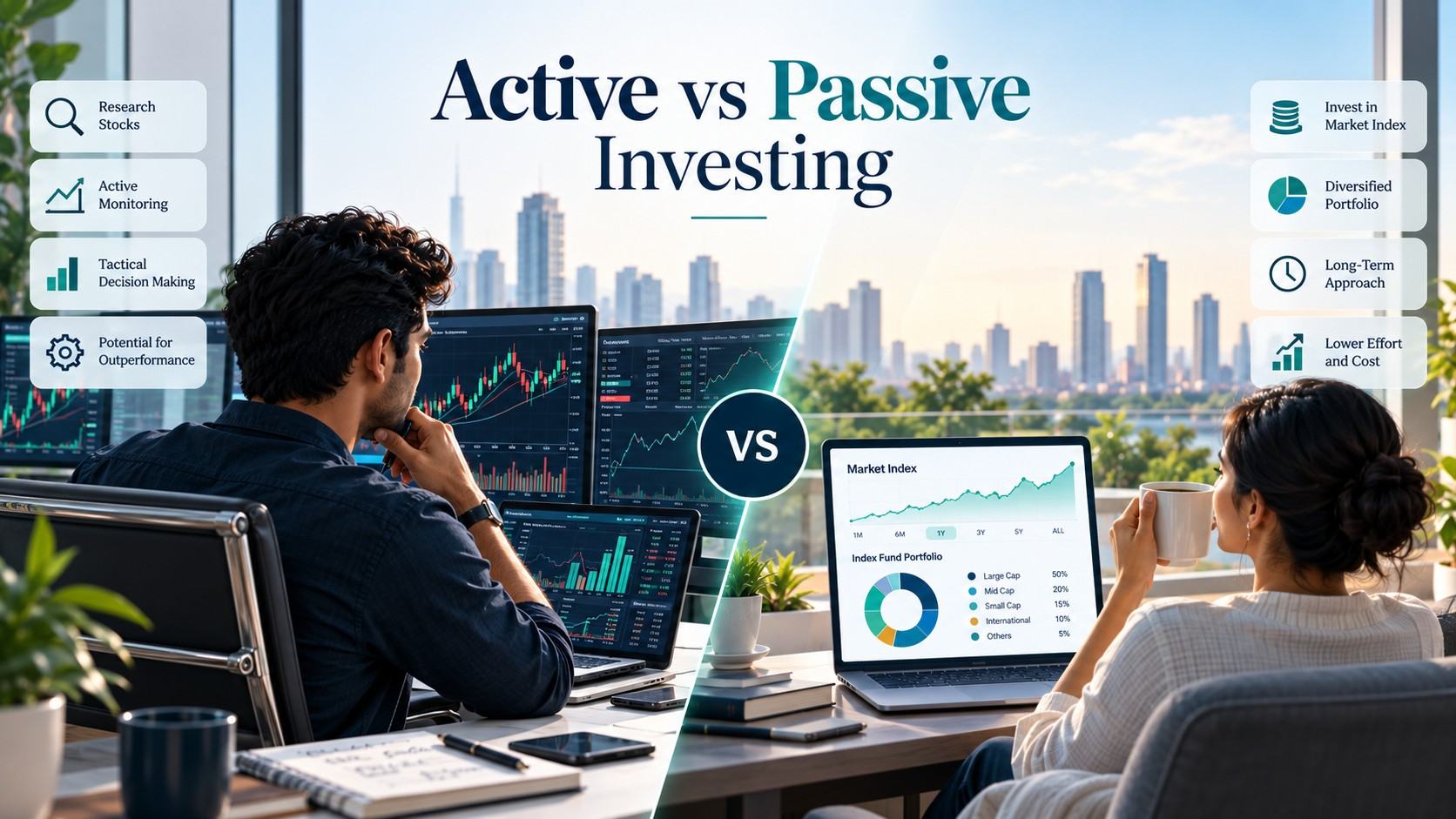
Should you try to outperform the stock market, or invest in a fund that simply aims to track it?
This is the most raised question behind Active vs Passive investing. Both approaches offer ways to participate in financial markets, but they differ in how investments are selected, how much research is involved, what they cost, and how their performance is evaluated.
Consider two investors, Kavya and Rishabh. Kavya invests in an Actively Managed Mutual Fund whose manager researches companies and selects stocks in an attempt to outperform a benchmark.
Rishabh chooses an index fund that aims to replicate the performance of a market index.
Neither strategy guarantees better returns. The right choice depends on your Financial Goals, Costs, Investment Horizon, Risk Tolerance, and confidence in the investment approach.
Let's examine how each strategy works, what market data tells us, and how Indian investors can make a more informed choice.
What Is Active Investing?
Active investing involves making investment decisions with the aim of outperforming a benchmark or achieving a specific investment objective.
In an actively managed mutual fund, a professional fund manager and research team analyses companies, industries, economic conditions, valuations, and other relevant factors to decide what to buy, hold, or sell.
For example, an active fund manager might believe that a manufacturing company is undervalued because its order book is growing faster than the market expects. The manager may increase the fund's allocation to that company, provided it fits the fund house mandate and risk limits.
The goal is to generate better performance than a relevant benchmark after accounting for costs. However, the analysis by the manager can be wrong, and the fund may underperform the market.
Key features of active investing
-
Research driven decisions: Investments are selected using fundamental analysis, technical analysis, or other strategies.
-
Portfolio adjustments: Holdings may change as market conditions, valuations, or company prospects evolve.
-
Potential for outperformance: A successful strategy may outperform its benchmark.
-
Higher costs in many cases: Research, management, and portfolio activity can increase expenses relative to comparable passive funds.
-
Manager and strategy risk: Results depend partly on the investment process and its execution.
Active investing is not necessarily frequent trading. A fund manager may actively manage a portfolio while holding selected companies for several years.
What Is Passive Investing?
Passive investing follows a different philosophy: rather than attempting to beat the market, it aims to replicate the performance of a chosen index.
A passive mutual fund or Exchange-traded fund (ETF) may track an index such as the Nifty 50. Its portfolio is constructed to reflect the index's constituents and weights, subject to the fund's methodology.
The investment outcome is therefore linked closely to the index's performance, less expenses and tracking differences.
Consider Rishabh invests in a Nifty 50 index fund. Instead of depending on a manager to identify which large companies will outperform, his fund follows the index. When the index changes its constituents or weights, the fund adjusts its portfolio to reflect those changes.
Key features of passive investing
-
Index based approach: Investments follow a defined benchmark.
-
Generally lower costs: Passive funds typically require less active research and portfolio decision-making.
-
Transparency: Investors can understand which index the fund tracks.
-
Reduced dependence on manager stock selection: Performance is primarily linked to the underlying index.
-
Benchmark-linked returns: The objective is to track the index, not consistently outperform it.
Passive investing still carries market risk. If the index falls, a fund tracking that index will generally fall as well. A broad index can provide diversification, but it cannot eliminate losses or ensure that every constituent performs well.
Active vs Passive Investing: Key Differences
|
Factor |
Active investing |
Passive investing |
|
Main objective |
Attempt to outperform a benchmark or meet a strategy-specific objective |
Track a selected index |
|
Investment decisions |
Based on research and manager judgement |
Based on index rules |
|
Portfolio changes |
May change with the manager's investment decisions |
Usually change when the index or its weights change |
|
Costs |
Often higher, depending on the fund |
Generally lower for comparable index exposure |
|
Performance |
May outperform or underperform its benchmark |
Seeks to match index performance before costs |
|
Main dependency |
Investment process and manager execution |
Index composition and tracking efficiency |
|
Suitable for |
Investors comfortable evaluating active strategies |
Investors seeking straightforward, benchmark-linked exposure |
One important diffrence: passive does not mean free of risk, and active does not automatically mean superior. The comparison must consider the fund category, benchmark, costs, investment horizon, and risk.
What Does the Data Say About Active Fund Performance?
A fund's performance in one year does not tell you whether its strategy is consistently effective. Comparing active funds against appropriate benchmarks over multiple periods can offer a more useful perspective.
The S&P Dow Jones Indices SPIVA India Year-End 2025 report provides a relevant example.
Active fund underperformance in India
|
Fund category |
Underperformance rate over 10 years |
|
Indian equity large-cap funds |
76.3% |
|
Indian ELSS funds |
82.9% |
|
Indian government bond funds |
75.6% |
Source: S&P Dow Jones Indices, SPIVA India Year-End 2025. Figures represent the share of funds that underperformed their respective benchmarks over the decade ending December 2025.
These figures highlight a challenge for active investors: outperforming a benchmark consistently over long periods can be difficult.
However, the data does not mean that every active fund underperforms. The report also found that active Indian mid and small cap funds had a stronger relative showing in 2025, with only 12.1% underperforming their benchmark that year.
What does this mean for investors?
Neither a single year's result nor one category performance should determine your entire investment strategy. The evidence supports evaluating active funds carefully, comparing like with like, and examining performance across multiple market conditions.
Past performance does not guarantee future results.
The Cost Difference: Why Small Percentages Matter
Investment costs can influence long term outcomes because fees reduce the amount of money that remains invested.
Consider two hypothetical funds offering exposure to a similar market segment:
-
Fund A is actively managed and has an annual expense ratio of 1.5%.
-
Fund B is a passive index fund and has an annual expense ratio of 0.3%.
The difference is 1.2% points per year.
For an investment of ₹5 lakh, that difference represents ₹6,000 in the first year if applied to the same starting amount. Actual expenses vary with the investment value and fund structure.
Over a longer period, the effect can compound because money paid in expenses is no longer available to earn investment returns.
However, expense ratios are not the only consideration.
An active fund may justify a higher cost if it delivers an appropriate investment outcome, but that outcome should be evaluated rather than assumed. Investors should also consider tracking error in passive funds, transaction-related costs where relevant, taxes, and the fund's suitability.
The objective is not simply to choose the cheapest fund. It is to understand what you are paying for and whether the investment approach serves your needs.
A Practical Example: Two Investors, Two Strategies
Meet Ananya and Mihir, both investing ₹10,000 every month for a long-term goal.
Ananya chooses an actively managed equity mutual fund after reviewing its investment strategy, benchmark performance, portfolio, risk profile, and expenses.
Mihir selects a passive index fund that tracks a broad market index. He prefers a transparent approach that does not depend on a manager selecting outperforming stocks.
Both invest consistently, review their portfolios periodically, and avoid reacting to every market headline.
Their results will depend on their chosen funds, market performance, fees, and the timing of their investments.
Ananya's fund may outperform or underperform its benchmark.
Mihir's fund will aim to track its index, but its actual return will differ because of expenses and tracking differences.
The lesson is that the investment process matters more than the label alone.
Ananya needs to assess whether the active fund's strategy remains effective. Mihir needs to understand what his chosen index includes and whether its concentration and risk suit his goals.
Both need discipline.
Can You Combine Active and Passive Investing?
Yes. Active and passive strategies do not have to be mutually exclusive.
An investor might use a broad-market index fund for core equity exposure and selectively add an active fund for a specific investment objective. The allocation should depend on financial goals, risk tolerance, existing holdings, and the investor's ability to evaluate the additional strategy.
For example, a 32-year-old investor might prefer passive exposure for simplicity while using a carefully selected active fund for another part of a long term portfolio. That combination is not automatically better than either strategy alone; it must serve a clear purpose and avoid unnecessary overlap.
Before combining funds, ask:
-
Do the funds provide meaningfully different exposure?
-
Does the active fund have a clear investment process?
-
Are its results reasonable relative to an appropriate benchmark?
-
Are the additional costs justified?
-
Does the combined portfolio fit my goals and risk tolerance?
Diversification is about spreading risk meaningfully, not merely increasing the number of funds.
How 5nance Can Fit Into Your Investment Approach
Choosing between active and passive investing is only one part of building a portfolio. Investors also need to decide how their funds work together and how to review investment decisions over time.
Depending on your needs, 5nance offers tools and advisory services that can support different parts of this process.
MF Baskets: A portfolio-level approach
5nance MF Baskets offer curated portfolios of Direct Mutual Funds organised around investment objectives and risk profiles. Investors can use a portfolio based approach to assess how different funds fit together, rather than evaluating each scheme in isolation.
Before choosing a basket, review its holdings, investment objective, risk profile, costs, and suitability. A curated portfolio does not guarantee returns or remove market risk.
Algrow: AI-driven mutual fund advisory
5nance Algrow uses AI-driven analysis to support mutual fund investment decisions, including switching recommendations. This may be relevant for investors who want a more structured way to review mutual fund opportunities rather than relying solely on recent performance or market sentiment.
AI-assisted recommendations should still be evaluated in context. Switching can introduce costs and tax implications, and no analytical system can guarantee that a decision will outperform the market.
These offerings serve different needs: MF Baskets focus on curated mutual fund portfolios, while Algrow supports data-led mutual fund decision-making. Neither should be assumed to replace the investor's need to understand risk and investment objectives.
How to Decide Which Strategy Suits You
Use this quick checklist before investing.
Passive investing may appeal to you if:
-
You want exposure to a defined market index.
-
You prefer a straightforward, rules-based approach.
-
Keeping costs low is a priority.
-
You do not want to depend on a fund manager consistently beating a benchmark.
Active investing may appeal to you if:
-
You understand the fund's strategy and benchmark.
-
You are willing to assess performance, costs, and portfolio changes.
-
You accept that the fund may underperform the market.
-
You believe the strategy serves a specific role in your portfolio.
If you are unsure, avoid choosing based on recent returns alone. Compare fund documents, benchmark performance, expenses, risk, and the role each investment would play in your broader financial plan.
Conclusion: Choose a Strategy, Not a Trend
Active vs passive investing is not a contest with one permanent winner. Active investing offers the possibility of outperforming a benchmark, but it requires careful fund selection and acceptance of underperformance risk.
Passive investing offers a rules-based way to track a market index, generally at a lower cost, but it also participates in market declines and cannot guarantee positive returns.
For Indian investors, the practical starting point is to define a goal, understand risk, compare costs, and evaluate the strategy over an appropriate period. Some investors may prefer passive funds, others may prefer active management, and some may choose a carefully constructed combination
If you want help evaluating mutual funds as part of a broader portfolio, explore 5nance's MF Baskets and Algrow offerings. Focus on building an investment process that is understandable, cost-conscious, and aligned with your long-term goals.
Frequently Asked Questions
1. What is the main difference between Active and Passive investing?
Active investing attempts to outperform a benchmark through investment decisions, while passive investing aims to replicate the performance of a chosen index.
2. Is passive investing better than active investing?
Not universally. Passive investing is generally simpler and often less expensive, while active investing may outperform or underperform. Compare suitable funds, costs, risk, and long-term performance before deciding.
3. Are index funds considered passive investments?
Yes. Index mutual funds generally follow a specified market index rather than selecting investments with the primary aim of outperforming it.
4. Why do active mutual funds sometimes underperform their benchmarks?
Possible reasons include investment decisions that do not work as expected, market conditions, portfolio positioning, expenses, and difficulty consistently identifying securities that outperform the benchmark.
5. Can I invest in both active and passive mutual funds?
Yes. A combination may suit some investors, provided each fund serves a clear purpose and the overall portfolio remains appropriate for their goals, risk tolerance, and investment horizon.
6. How should I compare active and passive mutual funds?
Compare funds within relevant categories, using appropriate benchmarks and consistent time periods. Examine expenses, portfolio composition, risk, tracking error for passive funds, and the active fund's investment process.
7. Can AI help with active investing decisions?
AI can support research, analysis, and investment recommendations. However, it cannot guarantee outperformance or eliminate risk. Investors should assess the suitability, costs, and implications of any recommendation before acting.
Sources and References
-
S&P Dow Jones Indices — SPIVA India Year-End 2025.
-
Securities and Exchange Board of India (SEBI) Investor — Index Mutual Funds.
-
SEBI — Investor Education and Mutual Fund Resources.
-
Association of Mutual Funds in India (AMFI) — Mutual Fund Data and Investor Resources.
Disclaimer
This article is for educational purposes only and does not constitute investment advice or a recommendation to buy, hold, or sell any security or mutual fund. Mutual fund investments are subject to market risks. Read all scheme-related documents carefully before investing. Past performance does not guarantee future results. Consider your financial goals, investment horizon, risk tolerance, expenses, and tax implications before making investment decisions. Consult a SEBI-registered investment adviser if you require personalised guidance.

